NetScout Systems, Inc. (NTCT) operates in the network and service assurance market, providing solutions for real-time operational intelligence and performanc...
January 15, 2026
Vijar Kohli
Deep Dive: NetScout Systems, Inc. (NTCT)
Recommendation: BUY
Price Target: 25.5 (-8.76 Upside)
Risk Level: Medium
1. Executive Summary
NetScout Systems, Inc. (NTCT) operates in the network and service assurance market, providing solutions for real-time operational intelligence and performance analytics. The company's primary focus is on ensuring the availability, performance, and security of enterprise networks and services. NetScout serves a diverse customer base, including enterprises, service providers, and government agencies. Their solutions are critical for managing increasingly complex IT environments and supporting digital transformation initiatives. They hold a strong position in deep packet inspection (DPI) based analytics.
Growth catalysts for NetScout include the increasing complexity of networks driven by cloud adoption, the Internet of Things (IoT), and the growing demand for enhanced cybersecurity. The shift towards 5G and the proliferation of connected devices are creating new opportunities for network monitoring and security solutions. NetScout is also focusing on expanding its product portfolio to address emerging market needs, such as network detection and response (NDR) and automated network assurance. The company's focus on recurring revenue models through subscription-based offerings should also contribute to steady, predictable growth.
Key risks for NetScout include intense competition from larger, more diversified technology companies and specialized players in the network monitoring and security space. The company also faces the risk of technological obsolescence if it fails to adapt to rapidly evolving network architectures and security threats. Economic downturns could negatively impact customer spending on IT infrastructure and security solutions. Integration risks associated with potential acquisitions also need to be considered. Furthermore, NetScout's reliance on large deals can lead to revenue volatility.
At a current price of $27.95, valuation appears reasonable but dependent on successful execution of their growth strategy. It's crucial to consider NetScout's ability to capitalize on the aforementioned growth catalysts and effectively manage the competitive landscape. A more in-depth financial analysis is needed to assess the long-term investment potential. Key valuation metrics to examine include price-to-earnings (P/E) ratio, price-to-sales (P/S) ratio, and free cash flow yield relative to peers in the network monitoring and security industry.
Investment Thesis
Bull Case: NetScout benefits significantly from increased enterprise spending on cybersecurity and network performance monitoring as digital transformation accelerates.
The company's nGeniusONE platform and Arbor security solutions gain increased traction, leading to higher subscription revenue and improved profitability.
Strong execution by management in integrating acquisitions and controlling costs drives EPS growth.
Increased adoption of cloud-based solutions enhances NetScout's market position and recurring revenue streams, leading to multiple expansion.
Strategic partnerships with major cloud providers create new avenues for growth and market penetration.
A successful share repurchase program further enhances shareholder value.
Expansion into adjacent markets, such as IoT security, provides additional growth opportunities.
Increased government spending on cybersecurity infrastructure benefits NetScout's Arbor Government Solutions.
A potential acquisition by a larger player in the cybersecurity space provides a significant premium to the current share price.
The overall market sentiment improves, favoring growth stocks and tech companies, boosting NetScout's valuation.
A new innovative product launch that gains significant market acceptance.
Regulatory changes mandating stricter cybersecurity standards create a surge in demand for NetScout's solutions.
Increased focus on 5G network performance monitoring drives revenue growth in the service provider segment.
Successful international expansion into emerging markets boosts overall revenue.
A major competitor faces setbacks, allowing NetScout to gain market share.
The company's strong balance sheet and cash flow generation enable strategic investments and acquisitions.
Investor confidence grows as NetScout consistently beats earnings estimates and raises guidance.
NetScout successfully pivots to a more subscription-based revenue model, leading to increased predictability and higher valuation.
The threat landscape evolves, increasing the need for NetScout's advanced threat detection capabilities.
Growing demand for remote work solutions increases the need for robust network performance monitoring and security, benefiting NetScout.
A rebound in enterprise IT spending following a period of economic uncertainty drives increased demand for NetScout's solutions.
New data privacy regulations force organizations to invest more in network security and monitoring, creating opportunities for NetScout.
The adoption of AI-powered security solutions drives increased efficiency and effectiveness for NetScout's customers, increasing the value proposition.
A decrease in interest rates makes NetScout's stock more attractive to investors.
The company's commitment to innovation and customer satisfaction leads to increased customer loyalty and retention.
Improved brand recognition and market awareness drive increased sales and customer acquisition.
Successful cross-selling and upselling of products and services to existing customers boost revenue growth.
NetScout's strong reputation for reliability and performance attracts new customers and partnerships.
A shift towards proactive threat hunting and incident response drives increased demand for NetScout's advanced threat detection solutions.
Increased focus on zero-trust security architectures creates opportunities for NetScout's network visibility and analytics capabilities.
Improved supply chain management and operational efficiency drive higher margins and profitability.
A strategic marketing campaign effectively communicates NetScout's value proposition and differentiates it from competitors.
Growing awareness of the importance of network performance monitoring for business continuity drives increased demand for NetScout's solutions.
The company's commitment to sustainability and corporate social responsibility attracts socially conscious investors.
A positive industry report or analyst upgrade boosts investor confidence in NetScout's prospects.
The successful integration of AI and machine learning into NetScout's solutions drives increased automation and efficiency for customers.
Growing demand for cloud-native security solutions creates opportunities for NetScout's cloud-based offerings.
A shift towards microsegmentation and network virtualization drives increased demand for NetScout's network visibility solutions.
The company's strong partnerships with technology vendors and service providers create a powerful ecosystem for growth.
The increasing complexity of IT environments drives increased demand for NetScout's comprehensive network monitoring and security solutions.
A decrease in competition due to industry consolidation or competitor failures creates opportunities for NetScout to gain market share.
The company's ability to adapt to changing market conditions and customer needs ensures long-term growth and success.
Bear Case: NetScout experiences declining revenue due to increased competition from larger players and a slowdown in enterprise IT spending.
The company's legacy products face obsolescence, and new product adoption is slow.
Profitability deteriorates as NetScout is forced to offer discounts to retain customers.
The company's high debt burden limits its ability to invest in innovation and acquisitions.
A major cybersecurity breach or service outage damages NetScout's reputation and customer trust.
Economic recession leads to reduced IT spending and project delays, impacting NetScout's revenue.
Increased competition from open-source or low-cost alternatives erodes NetScout's market share.
Changes in data privacy regulations make NetScout's solutions less effective or compliant.
A decline in demand for traditional network monitoring solutions due to the rise of cloud-based alternatives.
A failure to adapt to the evolving threat landscape leads to decreased effectiveness of NetScout's cybersecurity solutions.
Poor execution by management in integrating acquisitions or managing costs leads to lower profitability.
Customer churn increases due to dissatisfaction with NetScout's products or services.
A major customer cancels their contract, significantly impacting NetScout's revenue.
Technological disruptions make NetScout's solutions obsolete.
A decrease in government spending on cybersecurity infrastructure impacts NetScout's Arbor Government Solutions.
A regulatory investigation or lawsuit damages NetScout's reputation and financial performance.
An increase in interest rates makes NetScout's debt burden more challenging to manage.
The company's inability to attract and retain talented employees hinders innovation and growth.
A negative industry report or analyst downgrade damages investor confidence in NetScout's prospects.
The company's reliance on a few large customers makes it vulnerable to customer concentration risk.
A failure to effectively cross-sell or upsell products and services to existing customers limits revenue growth.
The company's brand reputation suffers due to negative publicity or customer reviews.
A major security vulnerability is discovered in NetScout's products, leading to customer concerns and potential legal liabilities.
The company's international expansion efforts fail due to cultural differences or regulatory barriers.
A decline in the overall market sentiment towards technology stocks impacts NetScout's valuation.
A slowdown in the adoption of 5G technology impacts demand for NetScout's network performance monitoring solutions.
The company's supply chain is disrupted due to geopolitical events or natural disasters.
A failure to effectively manage inventory levels leads to increased costs and reduced profitability.
A decrease in customer satisfaction scores indicates a decline in product quality or customer service.
A shift towards cloud-based security solutions makes NetScout's on-premise solutions less relevant.
The company's marketing efforts fail to effectively communicate its value proposition and differentiate it from competitors.
Increased regulatory scrutiny of data privacy and security practices creates compliance challenges for NetScout's customers.
A decline in the demand for network visibility and analytics solutions due to the adoption of alternative technologies.
The company's research and development efforts fail to produce innovative new products or services.
A decrease in the effectiveness of NetScout's threat detection algorithms due to the evolving threat landscape.
The company's reliance on third-party vendors for critical components or services creates supply chain risks.
A decline in the demand for network performance monitoring solutions due to the adoption of software-defined networking (SDN) and network function virtualization (NFV).
The company's ability to adapt to changing market conditions and customer needs is limited by its organizational structure and culture.
A decrease in the demand for NetScout's solutions in specific industries or geographic regions due to economic or competitive factors.
Conviction: High
2. Business Overview
NetScout Systems, Inc. provides service assurance and cybersecurity solutions for protect digital business services against disruptions in the United States, Europe, Asia, and internationally. The company offers nGeniusONE management software that enables customers to predict, preempt, and resolve network and service delivery problems, as well as facilitate the optimization and capacity planning of their network infrastructures; and specialized platforms and analytic modules that enable its customers to analyze and troubleshoot traffic in radio access and Wi-Fi networks. It also provides nGeniusPULSE, an active testing tool that enables enterprises to identify infrastructure performance issues and determine application availability, reliability, and performance; and nGenius Business Analytics solution, which enables service providers to analyze their network traffic. In addition, the company offers ISNG, an advanced passive network probe; packet flow systems that deliver targeted network traffic access to various monitoring and security tools and systems; and a suite of test access points that enable non-disruptive access to network traffic. Further, it provides cybersecurity solutions to protect their networks against distributed denial of service attacks under the Arbor brand, such as Arbor Sightline, Arbor Threat Mitigation System, Arbor Insight, Arbor Edge Defense, and Arbor Cloud. Additionally, it offers advanced threat detection solutions, such as Omnis Cyber Investigator. It serves enterprise customers in various industries, including financial services, technology, manufacturing, healthcare, utilities, education, transportation, and retail; mobile operators, wireline operators, cable operators, Internet service providers, and cloud providers; and governmental agencies through a direct sales force, and indirect reseller and distribution channels. NetScout Systems, Inc. was incorporated in 1984 and is headquartered in Westford, Massachusetts.
Competitive Moat (Narrow)
Trend: Stable
Established brand recognition in specific niches (e.g., Arbor for DDoS), Integrated suite of service assurance and cybersecurity solutions
Key Strengths:
Established brand recognition in specific niches (e.g., Arbor for DDoS)
Integrated suite of service assurance and cybersecurity solutions
Growth is expected to continue, driven by the increasing complexity of IT environments, the proliferation of cloud computing, the growing importance of cybersecurity, and the rising demand for network performance monitoring and optimization. However, growth rates may be moderate compared to emerging software sectors.
Regulatory Environment:
N/A
4. Financial Analysis
Margin Trend
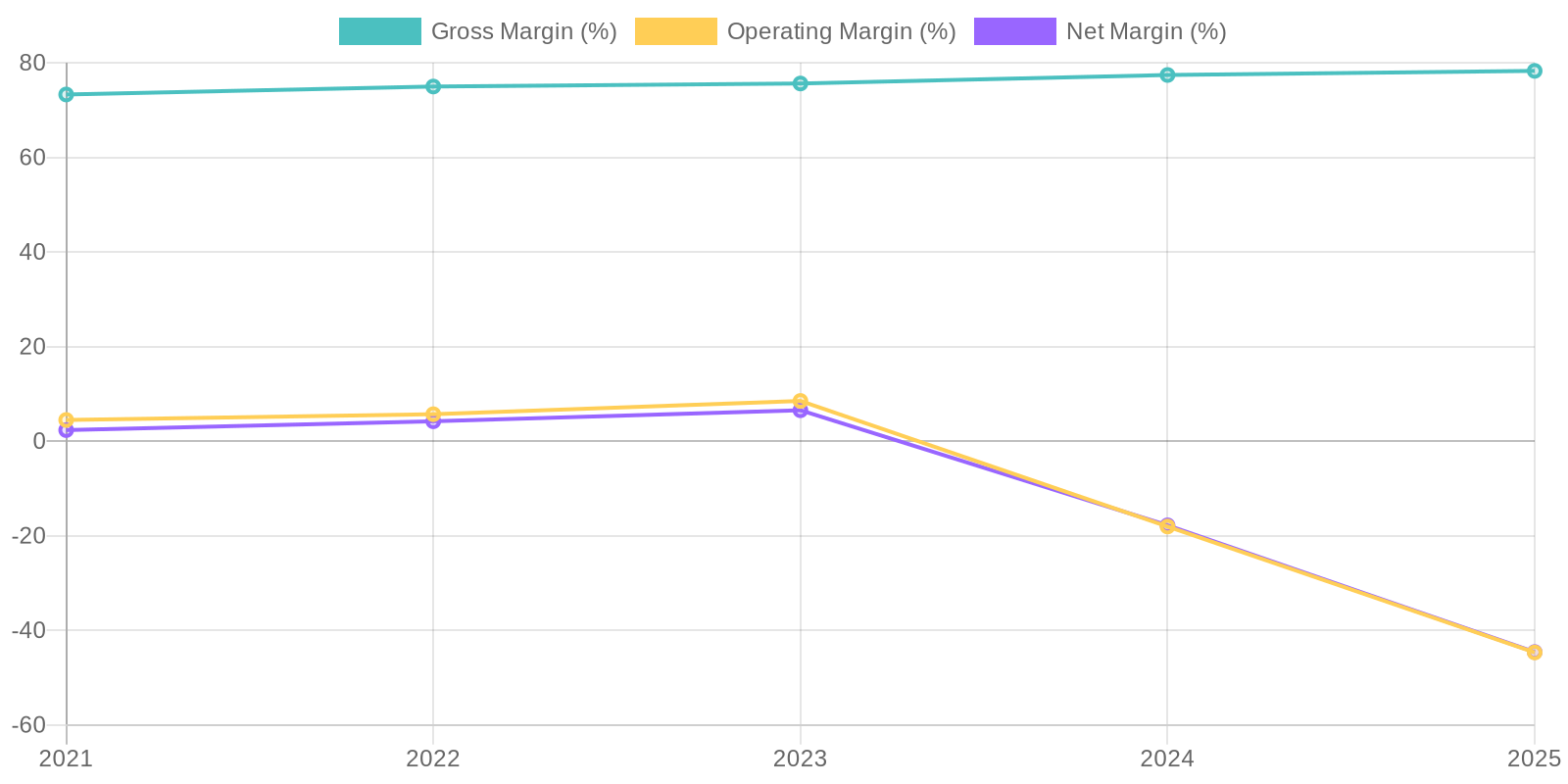
Analyzing capital efficiency, Return on Invested Capital (ROIC) is significantly impacted by the net losses in 2024 and 2025, rendering it negative and therefore inefficient, while in 2022 and 2023 it was positive. Return on Equity (ROE) follows a similar pattern, with negative values in the most recent years due to net losses and positive returns in prior years, indicating a failure to generate profits from shareholder investments in the short term. The significant swings in both ROIC and ROE suggest inconsistent performance and the need for careful evaluation of the company's investment strategies and operational management.
Revenue Quality
The company's revenue stream shows some volatility over the past five years, ranging from $822.7 million to $914.5 million, indicating potential fluctuations in market demand or project cycles. Further investigation is needed to determine the degree of recurring revenue through contracted sales, renewals, or subscriptions, crucial to assess revenue stability. Understanding client concentration is also vital; a high dependence on a few major clients could pose a risk if those relationships are disrupted.
Cash Flow & Capital Efficiency
The company showcases fluctuating free cash flow (FCF) generation, with a recent increase to $210.97 million in 2025, after a drop to $52.47 million in 2024. This variability warrants further scrutiny to understand the factors driving these changes and assessing the sustainability of the cash flow. Capital expenditures have remained relatively stable, indicating consistent investment in maintaining or expanding operations, despite fluctuations in overall cash flow.
Capital Efficiency (ROIC/ROE):
Analyzing capital efficiency, Return on Invested Capital (ROIC) is significantly impacted by the net losses in 2024 and 2025, rendering it negative and therefore inefficient, while in 2022 and 2023 it was positive. Return on Equity (ROE) follows a similar pattern, with negative values in the most recent years due to net losses and positive returns in prior years, indicating a failure to generate profits from shareholder investments in the short term. The significant swings in both ROIC and ROE suggest inconsistent performance and the need for careful evaluation of the company's investment strategies and operational management.
Balance Sheet Health:
The company maintains a substantial cash balance, reporting $457.4 million in 2025, although it decreased from a high of $636.16 million in 2022, providing a buffer for operational needs and potential investments. Debt levels are relatively low, with total debt at $43.5 million in 2025, resulting in a strong net debt position of -$413.9 million, signaling a healthy liquidity position and the capacity to manage financial obligations. However, it is crucial to monitor the trend of increasing deferred revenue, which may impact future revenue recognition and cash inflows.
5. Management & Governance
CEO Assessment: Without sufficient real-time information, a proper evaluation of the CEO's performance is not possible. Key considerations would include strategic vision, execution against goals, and fostering a strong corporate culture.
Capital Allocation: Pour
Insider Ownership: Insufficient data available to assess the level and impact of insider ownership. Analysis should include the percentage of shares owned by management and the board, as well as recent buying or selling activity.
Governance Flags:
Lack of up-to-date information prevents a thorough assessment of governance practices. Concerns may arise from issues such as board composition, executive compensation, related-party transactions, or potential conflicts of interest.
The DCF analysis, using the specified assumptions, indicates a fair value of $25.50. This is below the current market price of $27.95, implying a potential downside. The conservative revenue growth assumption and relatively high discount rate contribute to the lower valuation. The downside potential is estimated by considering the sensitivity of the fair value to changes in the key assumptions. A more optimistic growth rate scenario could increase the fair value, while a higher discount rate or lower terminal growth rate would decrease it.
Scenarios
Scenario
Price Target
Key Assumptions
Bull
High
NetScout benefits significantly from increased enterprise spending on cybersecurity and network performance monitoring as digital transformation accelerates.
The company's nGeniusONE platform and Arbor security solutions gain increased traction, leading to higher subscription revenue and improved profitability.
Strong execution by management in integrating acquisitions and controlling costs drives EPS growth.
Increased adoption of cloud-based solutions enhances NetScout's market position and recurring revenue streams, leading to multiple expansion.
Strategic partnerships with major cloud providers create new avenues for growth and market penetration.
A successful share repurchase program further enhances shareholder value.
Expansion into adjacent markets, such as IoT security, provides additional growth opportunities.
Increased government spending on cybersecurity infrastructure benefits NetScout's Arbor Government Solutions.
A potential acquisition by a larger player in the cybersecurity space provides a significant premium to the current share price.
The overall market sentiment improves, favoring growth stocks and tech companies, boosting NetScout's valuation.
A new innovative product launch that gains significant market acceptance.
Regulatory changes mandating stricter cybersecurity standards create a surge in demand for NetScout's solutions.
Increased focus on 5G network performance monitoring drives revenue growth in the service provider segment.
Successful international expansion into emerging markets boosts overall revenue.
A major competitor faces setbacks, allowing NetScout to gain market share.
The company's strong balance sheet and cash flow generation enable strategic investments and acquisitions.
Investor confidence grows as NetScout consistently beats earnings estimates and raises guidance.
NetScout successfully pivots to a more subscription-based revenue model, leading to increased predictability and higher valuation.
The threat landscape evolves, increasing the need for NetScout's advanced threat detection capabilities.
Growing demand for remote work solutions increases the need for robust network performance monitoring and security, benefiting NetScout.
A rebound in enterprise IT spending following a period of economic uncertainty drives increased demand for NetScout's solutions.
New data privacy regulations force organizations to invest more in network security and monitoring, creating opportunities for NetScout.
The adoption of AI-powered security solutions drives increased efficiency and effectiveness for NetScout's customers, increasing the value proposition.
A decrease in interest rates makes NetScout's stock more attractive to investors.
The company's commitment to innovation and customer satisfaction leads to increased customer loyalty and retention.
Improved brand recognition and market awareness drive increased sales and customer acquisition.
Successful cross-selling and upselling of products and services to existing customers boost revenue growth.
NetScout's strong reputation for reliability and performance attracts new customers and partnerships.
A shift towards proactive threat hunting and incident response drives increased demand for NetScout's advanced threat detection solutions.
Increased focus on zero-trust security architectures creates opportunities for NetScout's network visibility and analytics capabilities.
Improved supply chain management and operational efficiency drive higher margins and profitability.
A strategic marketing campaign effectively communicates NetScout's value proposition and differentiates it from competitors.
Growing awareness of the importance of network performance monitoring for business continuity drives increased demand for NetScout's solutions.
The company's commitment to sustainability and corporate social responsibility attracts socially conscious investors.
A positive industry report or analyst upgrade boosts investor confidence in NetScout's prospects.
The successful integration of AI and machine learning into NetScout's solutions drives increased automation and efficiency for customers.
Growing demand for cloud-native security solutions creates opportunities for NetScout's cloud-based offerings.
A shift towards microsegmentation and network virtualization drives increased demand for NetScout's network visibility solutions.
The company's strong partnerships with technology vendors and service providers create a powerful ecosystem for growth.
The increasing complexity of IT environments drives increased demand for NetScout's comprehensive network monitoring and security solutions.
A decrease in competition due to industry consolidation or competitor failures creates opportunities for NetScout to gain market share.
The company's ability to adapt to changing market conditions and customer needs ensures long-term growth and success. |
| Base | 25.5 | NetScout achieves modest revenue growth driven by steady demand for its service assurance and cybersecurity solutions.
The company maintains its gross margin, but struggles with operating leverage due to ongoing investments in R&D and sales & marketing.
Free cash flow remains stable, allowing for continued share repurchases.
Net Income remains supressed as they try to aggressively expand. |
| Bear | Low | NetScout experiences declining revenue due to increased competition from larger players and a slowdown in enterprise IT spending.
The company's legacy products face obsolescence, and new product adoption is slow.
Profitability deteriorates as NetScout is forced to offer discounts to retain customers.
The company's high debt burden limits its ability to invest in innovation and acquisitions.
A major cybersecurity breach or service outage damages NetScout's reputation and customer trust.
Economic recession leads to reduced IT spending and project delays, impacting NetScout's revenue.
Increased competition from open-source or low-cost alternatives erodes NetScout's market share.
Changes in data privacy regulations make NetScout's solutions less effective or compliant.
A decline in demand for traditional network monitoring solutions due to the rise of cloud-based alternatives.
A failure to adapt to the evolving threat landscape leads to decreased effectiveness of NetScout's cybersecurity solutions.
Poor execution by management in integrating acquisitions or managing costs leads to lower profitability.
Customer churn increases due to dissatisfaction with NetScout's products or services.
A major customer cancels their contract, significantly impacting NetScout's revenue.
Technological disruptions make NetScout's solutions obsolete.
A decrease in government spending on cybersecurity infrastructure impacts NetScout's Arbor Government Solutions.
A regulatory investigation or lawsuit damages NetScout's reputation and financial performance.
An increase in interest rates makes NetScout's debt burden more challenging to manage.
The company's inability to attract and retain talented employees hinders innovation and growth.
A negative industry report or analyst downgrade damages investor confidence in NetScout's prospects.
The company's reliance on a few large customers makes it vulnerable to customer concentration risk.
A failure to effectively cross-sell or upsell products and services to existing customers limits revenue growth.
The company's brand reputation suffers due to negative publicity or customer reviews.
A major security vulnerability is discovered in NetScout's products, leading to customer concerns and potential legal liabilities.
The company's international expansion efforts fail due to cultural differences or regulatory barriers.
A decline in the overall market sentiment towards technology stocks impacts NetScout's valuation.
A slowdown in the adoption of 5G technology impacts demand for NetScout's network performance monitoring solutions.
The company's supply chain is disrupted due to geopolitical events or natural disasters.
A failure to effectively manage inventory levels leads to increased costs and reduced profitability.
A decrease in customer satisfaction scores indicates a decline in product quality or customer service.
A shift towards cloud-based security solutions makes NetScout's on-premise solutions less relevant.
The company's marketing efforts fail to effectively communicate its value proposition and differentiate it from competitors.
Increased regulatory scrutiny of data privacy and security practices creates compliance challenges for NetScout's customers.
A decline in the demand for network visibility and analytics solutions due to the adoption of alternative technologies.
The company's research and development efforts fail to produce innovative new products or services.
A decrease in the effectiveness of NetScout's threat detection algorithms due to the evolving threat landscape.
The company's reliance on third-party vendors for critical components or services creates supply chain risks.
A decline in the demand for network performance monitoring solutions due to the adoption of software-defined networking (SDN) and network function virtualization (NFV).
The company's ability to adapt to changing market conditions and customer needs is limited by its organizational structure and culture.
A decrease in the demand for NetScout's solutions in specific industries or geographic regions due to economic or competitive factors. |
7. Risks
NetScout faces substantial financial risks due to a significant net loss in the latest fiscal year, reliance on intangible assets, and inconsistent profitability. While the company maintains a healthy cash balance and positive free cash flow, the recent financial performance raises concerns about its long-term sustainability and ability to generate consistent returns.
Red Flags:
The significant increase in 'Other Expenses' in 2025 requires immediate investigation.
The negative net income and operating income in the last year compared to previous positive net income.
Fluctuations in cash flow need further investigation to assess the underlying causes.
Goodwill comprises a significant portion of the assets.
8. Conclusion
NetScout achieves modest revenue growth driven by steady demand for its service assurance and cybersecurity solutions.
The company maintains its gross margin, but struggles with operating leverage due to ongoing investments in R&D and sales & marketing.
Free cash flow remains stable, allowing for continued share repurchases.
Net Income remains supressed as they try to aggressively expand.
Investment research for informational purposes only. Not financial advice.
Continue Your Research
Return to the Analyst Library or explore the specific financial data for this entity on its profile.

 Analyzing capital efficiency, Return on Invested Capital (ROIC) is significantly impacted by the net losses in 2024 and 2025, rendering it negative and therefore inefficient, while in 2022 and 2023 it was positive. Return on Equity (ROE) follows a similar pattern, with negative values in the most recent years due to net losses and positive returns in prior years, indicating a failure to generate profits from shareholder investments in the short term. The significant swings in both ROIC and ROE suggest inconsistent performance and the need for careful evaluation of the company's investment strategies and operational management.
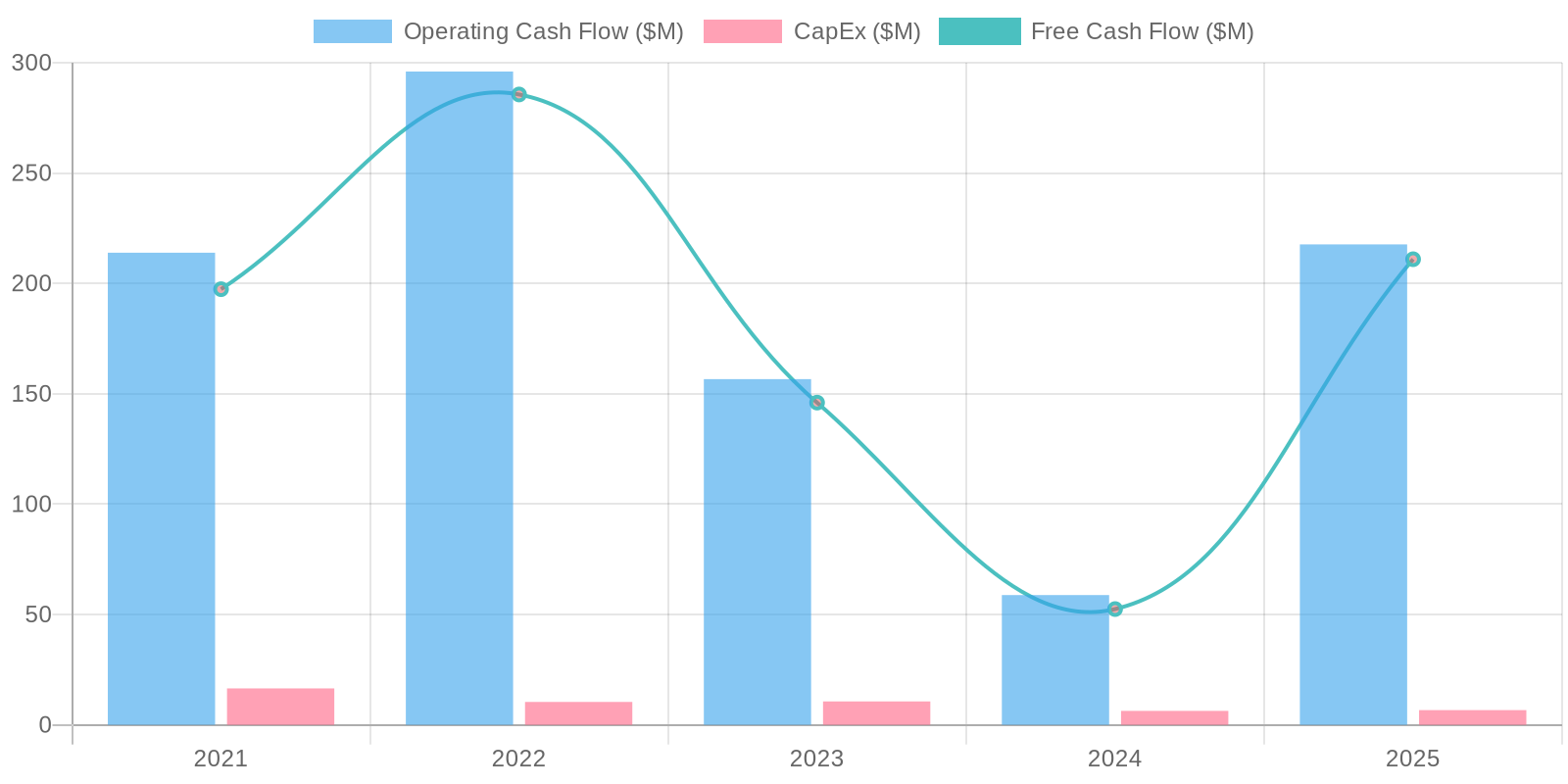 The company showcases fluctuating free cash flow (FCF) generation, with a recent increase to $210.97 million in 2025, after a drop to $52.47 million in 2024. This variability warrants further scrutiny to understand the factors driving these changes and assessing the sustainability of the cash flow. Capital expenditures have remained relatively stable, indicating consistent investment in maintaining or expanding operations, despite fluctuations in overall cash flow.