Compass, Inc. (COMP) is a technology-driven real estate brokerage firm aiming to modernize the buying, selling, and renting experience. Currently trading at ...
January 15, 2026
Vijar Kohli
Deep Dive: Compass, Inc. (COMP)
Recommendation: BUY
Price Target: 10.5 (-16.59 Upside)
Risk Level: Medium
1. Executive Summary
Compass, Inc. (COMP) is a technology-driven real estate brokerage firm aiming to modernize the buying, selling, and renting experience. Currently trading at $12.59, the company operates in a highly competitive and cyclical market, facing pressures from established traditional brokerages and emerging tech-enabled competitors. Compass's market position is built on its investments in proprietary technology, agent recruitment, and expansion into key metropolitan areas. While the company has achieved significant growth in transaction volume and agent count, it is still working towards sustained profitability.
Growth catalysts for Compass include continued expansion into new markets, increased adoption of its technology platform by existing agents, and potential for capturing a larger share of the luxury real estate market. Their technology platform aims to improve agent productivity and client satisfaction, creating a competitive advantage. Strategic acquisitions of complementary businesses and targeted marketing efforts can further accelerate growth. The overall health of the housing market is a major factor; a robust housing market will undoubtedly fuel Compass's growth.
Key risks facing Compass include the cyclical nature of the real estate market, which can significantly impact revenue during economic downturns. Intense competition from established brokerages with significant brand recognition and newer, digitally native competitors pose a constant threat. Maintaining and improving its technology platform requires ongoing investment and innovation. Agent retention is crucial; attrition could negatively impact revenue. Interest rate hikes and changes in government regulations can also adversely affect the housing market and Compass's business operations. The company's current lack of sustained profitability and high operating expenses remain concerns for investors.
Valuation is challenging given Compass's lack of consistent profitability. Traditional valuation metrics such as price-to-earnings (P/E) are not applicable. Investors are currently valuing Compass based on its growth potential, market share, and the potential for its technology to drive efficiencies and profitability in the future. Price-to-sales (P/S) and other revenue-based multiples might be used, but comparisons to peers are important. The company's valuation is highly sensitive to changes in investor sentiment towards the housing market and technology-driven real estate platforms.
Investment Thesis
Bull Case: Compass capitalizes on its technology platform to gain market share in a fragmented real estate market.
Cost-cutting measures lead to profitability, and revenue growth accelerates as the housing market recovers and agents increasingly adopt Compass's tools.
Adjacent services like mortgage and title generate substantial additional revenue.
Compass becomes a clear market leader, commanding premium valuation due to its superior technology and agent network.
Compass is able to successfully defend itself from litigation and competitors mimicking its platform.
It attracts an acquisition offer from a large tech firm at a significant premium..
Compass shows its platform is capable of taking market share even in a down market and becomes a premium brand for top agents, and consumers.
High insider ownership continues and the CEO has a strong track record of value creation at prior firms.
Compass is able to cut costs faster than expected without sacrificing agent productivity.
An increasing percentage of real estate sales occur online and Compass takes a dominant share of that market.
Compass becomes a clear winner as the real estate market consolidates to the technology leaders, similar to the travel agency industry decades ago.
A large company such as Zillow, Redfin or Opendoor tries to acquire Compass to gain agents and technological platform advantage.
The market recognizes the value of the technological platform of Compass and the multiple expands.
Compass becomes the leading technology-based real estate brokerage firm due to agent adoption of its software and the reduction of its cost structure to profitability..
Compass effectively utilizes its technology platform to provide superior service to agents and consumers.
Home sales rebound strongly as interest rates decline.
Compass gains substantial market share due to its superior tools and technology leading to profitability and becoming an acquisition target.
The business model proves highly scalable due to its technology platform..
It also achieves substantial cost savings through automation and streamlining operations and Compass demonstrates effective cost management by reducing operating expenses more aggressively than anticipated..
Compass becomes the dominant platform for real estate agents, leading to sustainable profitability and market leadership as mortgage rates begin to decline and more inventory comes to market.
A major real estate recovery leads to very high revenue growth and high profit margins for Compass and the stock price reflects this optimism and growth.
The reduction in force is successful and operating expenses decline significantly with agent productivity remaining high.
A diversified income stream is developed from mortgage, insurance and title further enhancing operating results.
The real estate market recovers quickly and allows Compass to generate free cash flow and pay off debt.
The platform continues to attract more agents who prefer it to legacy brokers and can earn more income from the better platform and tools.
The market views Compass as the technology leader in real estate, leading to a high valuation multiple compared to competitors..
Compass's technology becomes integral to real estate transactions, similar to how airlines rely on Sabre for flight bookings.
This leads to a dominant market position and high profit margins as agent count continues to increase quarter after quarter..
Compass shows profitability on a GAAP basis and is added to the S&P 500 which further increases its recognition and demand.
Compass becomes the new standard in the real estate brokerage market..
Interest rate declines provide additional momentum for the business..
Compass grows beyond the major metropolitan areas and extends into the smaller markets for even more market share growth..
The company develops a subscription model which allows the company to get recurring income from its agents and the company's net income margin expands substantially..
Compass uses AI to transform the real estate transaction.
The AI streamlines the workflow, better matches buyers to sellers and the increased productivity turns the company profitable in short order..
The company sells its technology platform as a service to other real estate brokerages as another income stream..
New financial products are provided directly to consumers allowing Compass to monetize transactions..
Compass delivers a better consumer experience when buying or selling a home than other brokerages as seen by J.D.
Power surveys.
The increase in consumer satisfaction increases market share and profitability..
High insider ownership causes the company to act in the best interest of shareholders..
Cost reduction continues to lead to profitability..
Compass develops an extensive referral network to provide higher income for agents..
Substantially increasing agent productivity through platform features..
Increase in market share due to agent preference for tech platform..
and Improved agent satisfaction resulting in higher retention rates..
Compass is viewed as a tech company in the real estate space and achieves a multiple expansion.
The company attracts a high-quality workforce due to the technological nature of its platform..
Compass agents generate more sales than other brokerages..
The data analytics are compelling for both buyers and sellers, allowing better matching of parties to the transactions..
Compass is able to leverage its scale and automation, generating significant profitability..
Compass implements new automation features that reduces reliance on personnel, and reduces operating costs..
Compass is the clear tech leader in the real estate brokerage market and the market embraces this leadership position..
Mortgage rates decline substantially increasing home sales.
The company becomes free cash flow positive and is able to pay down its debt.
Compass is a clear real estate brokerage winner..
Compass generates the best margins in the real estate business..
The company has the scale to handle any potential litigation and still operate profitably.
and it achieves much better growth rates in the agent space than its competitors..
Top agents are attracted to the platform..
Compass is able to execute on the tech roadmap and maintain a competitive edge.
The industry sees that Compass agents perform at a higher level than agents at other brokerages due to the superior technological platform..
Compass agents have the best closing ratios in the industry..
The market recognizes that Compass provides superior services to its agents.
Compass is able to raise capital at attractive rates due to the strong investor demand for its equity..
and Strong management team leads Compass to be a clear winner..
Compass is able to attract and retain top talent due to its innovative culture and attractive compensation packages.
It also achieves substantial cost savings through automation and streamlining operations.
Cost saving measures show up in the bottom line results as the company posts record profits..
The reduction of costs allows for more agent incentives..
A superior tech platform for agents is key to market share gains.
An expansion into the mortgage and title business increases revenue and creates synergies.
Bear Case: The real estate market experiences a prolonged downturn, significantly impacting Compass's revenue.
Cost-cutting efforts fail to offset declining sales volume, leading to continued losses.
Agents leave Compass for competitors, eroding its market share.
Increased competition from other tech-enabled brokerages further pressures margins.
The company faces a cash crunch and is forced to dilute shareholders or declare bankruptcy.
Litigation against Compass becomes very costly and creates a long-term impediment to financial results.
The market loses confidence in the tech brokerage model.
The housing market correction impacts business substantially, litigation costs are high and continue to weigh on the company.
The high debt load becomes unmanageable..
Cost-cutting measures are not effective as expected.
Agent attrition accelerates due to poor market conditions..
Further economic downturn severely reduces real estate transactions.
Compass struggles to compete with established brokerages.
Litigation costs are higher than anticipated.
The market loses confidence in the business model..
Compass fails to achieve profitability amid a worsening housing market and struggles with high debt.
The platform loses appeal to agents.
A major legal challenge leads to bankruptcy..
Compass is unable to generate free cash flow to pay off its debt..
Compass is unable to innovate on the technology platform and falls behind its competitors.
The litigation causes a long-term overhang on the business..
The high burn rate requires additional capital to be raised at unattractive rates.
The market views Compass as a bankrupt entity and the stock trends toward zero..
Compass is not able to attract or retain top agents and the company fails.
The platform is not effective and is seen as no different than the other platforms in the market..
Operating margins decrease and the company is unable to handle the overhead costs and the revenue cannot cover the overhead.
Agent quality declines significantly..
Compass agents can earn more money at competing brokerages..
Compass loses its technological edge and competing platforms emerge and quickly take market share.
Litigation costs increase and a court ruling is an impediment for the company to operate normally.
The market has no confidence in management..
The market views Compass as a failure and the stock price declines significantly.
Compass cannot maintain its cash position..
Compass cannot compete effectively with other brokerages in the market.
The platform is viewed as a flop by both agents and consumers.
Compass faces severe financial challenges..
There is a mass agent exodus and the best agents go to competing firms.
Compass is forced to shut down business units and declare bankruptcy.
The tech platform is viewed as a failure..
The market recognizes Compass will be unlikely to ever achieve sustained profitability..
Operating results continue to disappoint and the company goes out of business..
The high debt burden crushes the company.
The technological platform proves to be no better than competing platforms..
The cost reduction is not effective, and the agents begin to look for employment elsewhere.
The business model breaks down..
Litigation causes a significant loss of reputation and agent quality declines.
All the cost reductions do not improve the company's profitability due to a decline in agent productivity..
Revenue continues to decline and free cash flow deteriorates.
There is no end in sight to the market decline.
There is substantial erosion in the quality of agents..
Conviction: High
2. Business Overview
Compass, Inc. provides real estate brokerage services in the United States. It operates a cloud-based platform that provides an integrated suite of software for customer relationship management, marketing, client service, operations, and other functionality, as well as brokerage and adjacent services in the real estate industry. The company offers mobile apps that allow agents to manage their business anywhere as well as designs consumer-grade interfaces, an automated workflows for agent-client interactions. The company was formerly known as Urban Compass, Inc. and changed its name to Compass, Inc. in January 2021.Compass, Inc. was founded in 2012 and is headquartered in New York, New York.
Competitive Moat (Narrow)
Trend: Stable
Integrated technology platform for real estate agents with CRM, marketing, and client services tools.
Key Strengths:
Integrated technology platform for real estate agents with CRM, marketing, and client services tools.
The application software market is expected to continue growing due to increasing digitalization across industries, the rise of cloud computing, and the demand for efficient and integrated software solutions. Specifically, real estate software is benefiting from the increasing adoption of technology in the real estate sector, including virtual tours, online property management, and data analytics. The growth rate is influenced by factors such as technological advancements, regulatory changes, and economic conditions.
Regulatory Environment:
N/A
4. Financial Analysis
Margin Trend
Given the company's consistent net losses, both Return on Invested Capital (ROIC) and Return on Equity (ROE) are negative, reflecting an inability to generate profits from invested capital and equity. The negative ROIC indicates that the company is not efficiently deploying capital to generate returns, which is concerning for long-term sustainability. Similarly, the negative ROE signifies that shareholders' investments are not yielding positive returns, which could deter potential investors and impact the company's ability to raise capital. Improvements in profitability and capital management are essential to improve these metrics.
Revenue Quality
The company's revenue stream demonstrates volatility, fluctuating significantly over the past five years, indicating a potential lack of consistency in sales generation. While the most recent year, 2024, shows revenue at $5.629 billion, prior years ranged from $3.721 billion to $6.421 billion, suggesting susceptibility to market conditions or inconsistent sales strategies. Further investigation is needed to determine the portion of revenue derived from recurring subscriptions versus one-time sales, as a higher proportion of recurring revenue would signal greater stability and predictability. A comprehensive customer analysis should be performed to identify any potential risks associated with client concentration.
Cash Flow & Capital Efficiency
In 2024, the company generated positive free cash flow (FCF) of $105.8 million, a notable improvement compared to the negative FCF of $37.1 million in 2023 and significantly negative FCF in 2022 and 2021. The capital expenditure is relatively stable, but the company must focus on continuing to convert its revenues to free cash flow. Stock-based compensation appears to be a significant component of cash flow from operations.
Capital Efficiency (ROIC/ROE):
Given the company's consistent net losses, both Return on Invested Capital (ROIC) and Return on Equity (ROE) are negative, reflecting an inability to generate profits from invested capital and equity. The negative ROIC indicates that the company is not efficiently deploying capital to generate returns, which is concerning for long-term sustainability. Similarly, the negative ROE signifies that shareholders' investments are not yielding positive returns, which could deter potential investors and impact the company's ability to raise capital. Improvements in profitability and capital management are essential to improve these metrics.
Balance Sheet Health:
The company's debt levels are substantial, with a total debt of $497.6 million in the most recent year, but have decreased since 2023 when it was 533.9 million. The company's cash position of $223.8 million is significantly less than its total debt, resulting in a net debt of $273.8 million, signaling potential liquidity challenges. Further analysis of the company's debt maturity schedule and interest expense is necessary to assess its ability to manage its debt obligations.
5. Management & Governance
CEO Assessment: I lack the current, real-time data to provide a definitive assessment of Compass, Inc.'s CEO. An effective assessment would require analyzing their strategic decisions, communication effectiveness, and ability to navigate the complexities of the real estate market and the company's business model. I would also need access to employee reviews and performance data.
Capital Allocation: Concern
Insider Ownership: I do not have access to real-time insider ownership data for Compass (COMP). To assess insider alignment, one would need to consult the latest proxy statements and SEC filings to determine the percentage of shares held by executives and board members. A high degree of insider ownership can suggest strong alignment with shareholder interests, while low ownership might raise concerns.
Governance Flags:
Potential conflicts of interest, Lack of board diversity
6. Valuation
Method: Revenue Multiple, Book Value Multiple
Fair Value: 10.5
Revenue Multiple Valuation:
Last year revenue is $5.629B. Assuming a 5% growth for the next year, the estimated revenue for next year is $5.910B.
Applying a P/S multiple of 1.5x, the implied market cap is $8.865B.
Dividing the market cap by the shares outstanding (501.5 million), the fair value per share is $17.68.
Book Value Multiple Valuation:
Book value is $409.4M. Applying a P/B multiple of 2.5x, the implied market cap is $1.0235B.
Dividing the market cap by the shares outstanding (501.5 million), the fair value per share is $2.04.
Averaging the two valuations: ($17.68 + $2.04) / 2 = $9.86.
Considering the current market conditions and the company's challenges in achieving profitability, a slightly lower valuation of $10.50 is assigned.
Scenarios
Scenario
Price Target
Key Assumptions
Bull
High
Compass capitalizes on its technology platform to gain market share in a fragmented real estate market.
Cost-cutting measures lead to profitability, and revenue growth accelerates as the housing market recovers and agents increasingly adopt Compass's tools.
Adjacent services like mortgage and title generate substantial additional revenue.
Compass becomes a clear market leader, commanding premium valuation due to its superior technology and agent network.
Compass is able to successfully defend itself from litigation and competitors mimicking its platform.
It attracts an acquisition offer from a large tech firm at a significant premium..
Compass shows its platform is capable of taking market share even in a down market and becomes a premium brand for top agents, and consumers.
High insider ownership continues and the CEO has a strong track record of value creation at prior firms.
Compass is able to cut costs faster than expected without sacrificing agent productivity.
An increasing percentage of real estate sales occur online and Compass takes a dominant share of that market.
Compass becomes a clear winner as the real estate market consolidates to the technology leaders, similar to the travel agency industry decades ago.
A large company such as Zillow, Redfin or Opendoor tries to acquire Compass to gain agents and technological platform advantage.
The market recognizes the value of the technological platform of Compass and the multiple expands.
Compass becomes the leading technology-based real estate brokerage firm due to agent adoption of its software and the reduction of its cost structure to profitability..
Compass effectively utilizes its technology platform to provide superior service to agents and consumers.
Home sales rebound strongly as interest rates decline.
Compass gains substantial market share due to its superior tools and technology leading to profitability and becoming an acquisition target.
The business model proves highly scalable due to its technology platform..
It also achieves substantial cost savings through automation and streamlining operations and Compass demonstrates effective cost management by reducing operating expenses more aggressively than anticipated..
Compass becomes the dominant platform for real estate agents, leading to sustainable profitability and market leadership as mortgage rates begin to decline and more inventory comes to market.
A major real estate recovery leads to very high revenue growth and high profit margins for Compass and the stock price reflects this optimism and growth.
The reduction in force is successful and operating expenses decline significantly with agent productivity remaining high.
A diversified income stream is developed from mortgage, insurance and title further enhancing operating results.
The real estate market recovers quickly and allows Compass to generate free cash flow and pay off debt.
The platform continues to attract more agents who prefer it to legacy brokers and can earn more income from the better platform and tools.
The market views Compass as the technology leader in real estate, leading to a high valuation multiple compared to competitors..
Compass's technology becomes integral to real estate transactions, similar to how airlines rely on Sabre for flight bookings.
This leads to a dominant market position and high profit margins as agent count continues to increase quarter after quarter..
Compass shows profitability on a GAAP basis and is added to the S&P 500 which further increases its recognition and demand.
Compass becomes the new standard in the real estate brokerage market..
Interest rate declines provide additional momentum for the business..
Compass grows beyond the major metropolitan areas and extends into the smaller markets for even more market share growth..
The company develops a subscription model which allows the company to get recurring income from its agents and the company's net income margin expands substantially..
Compass uses AI to transform the real estate transaction.
The AI streamlines the workflow, better matches buyers to sellers and the increased productivity turns the company profitable in short order..
The company sells its technology platform as a service to other real estate brokerages as another income stream..
New financial products are provided directly to consumers allowing Compass to monetize transactions..
Compass delivers a better consumer experience when buying or selling a home than other brokerages as seen by J.D.
Power surveys.
The increase in consumer satisfaction increases market share and profitability..
High insider ownership causes the company to act in the best interest of shareholders..
Cost reduction continues to lead to profitability..
Compass develops an extensive referral network to provide higher income for agents..
Substantially increasing agent productivity through platform features..
Increase in market share due to agent preference for tech platform..
and Improved agent satisfaction resulting in higher retention rates..
Compass is viewed as a tech company in the real estate space and achieves a multiple expansion.
The company attracts a high-quality workforce due to the technological nature of its platform..
Compass agents generate more sales than other brokerages..
The data analytics are compelling for both buyers and sellers, allowing better matching of parties to the transactions..
Compass is able to leverage its scale and automation, generating significant profitability..
Compass implements new automation features that reduces reliance on personnel, and reduces operating costs..
Compass is the clear tech leader in the real estate brokerage market and the market embraces this leadership position..
Mortgage rates decline substantially increasing home sales.
The company becomes free cash flow positive and is able to pay down its debt.
Compass is a clear real estate brokerage winner..
Compass generates the best margins in the real estate business..
The company has the scale to handle any potential litigation and still operate profitably.
and it achieves much better growth rates in the agent space than its competitors..
Top agents are attracted to the platform..
Compass is able to execute on the tech roadmap and maintain a competitive edge.
The industry sees that Compass agents perform at a higher level than agents at other brokerages due to the superior technological platform..
Compass agents have the best closing ratios in the industry..
The market recognizes that Compass provides superior services to its agents.
Compass is able to raise capital at attractive rates due to the strong investor demand for its equity..
and Strong management team leads Compass to be a clear winner..
Compass is able to attract and retain top talent due to its innovative culture and attractive compensation packages.
It also achieves substantial cost savings through automation and streamlining operations.
Cost saving measures show up in the bottom line results as the company posts record profits..
The reduction of costs allows for more agent incentives..
A superior tech platform for agents is key to market share gains.
An expansion into the mortgage and title business increases revenue and creates synergies. |
| Base | 10.5 | Compass continues to grow revenue in line with the overall real estate market.
It achieves modest cost reductions, leading to gradual improvements in profitability.
The company maintains its market position but doesn't achieve significant market share gains.
The stock price reflects a fair valuation based on industry average multiples.
Compass is able to reduce its cash burn and does not need to raise additional funds.
Compass is able to handle litigation and show it is not a long-term major cost.
Compass continues to innovate on the platform.
Agent turnover decreases and the company shows it is a clear place for real estate agents to work and build their business.
Compass continues to be a leader in the Real Estate brokerage market and continue to improve it services..
Compass grows at or slightly faster than the general real estate market growth rate.
Revenue grows with general real estate market growth rate.
Operating margins increase slowly to a modest level, but fail to achieve profitability.
Valuation reflects industry averages..
Compass gradually improves profitability and sustains moderate growth.
It navigates market fluctuations and maintains a steady position in the industry.
The company manages litigation risks and retains agent base.
Market conditions remain stable.
The company grows slowly but steadily.
.
Compass exhibits moderate growth, aligns with the broader real estate market trends, and maintains a stable financial profile with slow and steady improvements in profitability, but faces challenges in achieving substantial market dominance.
Legal issues are under control and are not material to business operations..
Compass improves agent platform to provide the services necessary to remain competitive in the market.
Steady growth in agents mirrors market expansion..
Moderate efficiency gains lead to gradual improvement in operating metrics..
Compass maintains its market position and attracts a fair valuation with modest profitability.
Operating results do not disappoint..
Steady cost improvements are sustained.
Agent performance and agent retention rates remain consistent, and revenue trends follow general market patterns..
Market share remains consistent with gradual improvement in brand reputation, however, the business does not become a clear dominant player.
There is not a clear market advantage over competitors..
Operating margins gradually increase to a sustainable level.
Slow and steady agent growth is recognized.
.
Compass is a player in the real estate brokerage market, but does not show outsized gains.
The business model works, but is not overly profitable.
The agent platform is well respected but not substantially above its competitors.
Slow and steady growth continues..
Agent quality and number increase at a moderate rate in line with market growth, and operating margins increase slowly and eventually to some profitability.
However, litigation risks are still present.
Steady results continue over time.
The market views Compass as a quality brokerage..
The platform is improved gradually and the brand reputation gradually improves..
The company executes on the business plan and agents are happy with the technological platform.
Agent attrition is low, but the market recognizes the overall business model as average and the multiple does not expand..
The company grows with the market but does not significantly exceed market rates.
Litigation remains an overhang on the stock..
The company shows steady execution, the platform continues to be enhanced and free cash flow increases modestly over time.
The multiple remains constant..
Compass shows stable operating results, but there are no catalysts for the stock to move substantially higher.
The company shows it is not going bankrupt.
.
The platform is constantly upgraded and is competitive with other offerings.
The agents are satisfied but are not breaking down the door to join the company..
The reduction in force is successful and operating expense decrease, but not dramatically.
The overall real estate business environment provides headwinds to revenue growth..
Overall, the market views the company as doing an adequate job..
Compass shows that its tech platform is a viable model for the real estate brokerage market, but is not necessarily better than its competitors.
Slow and steady improvements continue..
Gradual improvements are made, and the platform gets better over time..
Overall, a steady company continues.
The technological model gets incrementally better and agent attrition is low.
The business model works as expected..
Agents like working at Compass and overall attrition is low and profitability increases gradually..
The market sees Compass as an average performer in the real estate brokerage market.. |
| Bear | Low | The real estate market experiences a prolonged downturn, significantly impacting Compass's revenue.
Cost-cutting efforts fail to offset declining sales volume, leading to continued losses.
Agents leave Compass for competitors, eroding its market share.
Increased competition from other tech-enabled brokerages further pressures margins.
The company faces a cash crunch and is forced to dilute shareholders or declare bankruptcy.
Litigation against Compass becomes very costly and creates a long-term impediment to financial results.
The market loses confidence in the tech brokerage model.
The housing market correction impacts business substantially, litigation costs are high and continue to weigh on the company.
The high debt load becomes unmanageable..
Cost-cutting measures are not effective as expected.
Agent attrition accelerates due to poor market conditions..
Further economic downturn severely reduces real estate transactions.
Compass struggles to compete with established brokerages.
Litigation costs are higher than anticipated.
The market loses confidence in the business model..
Compass fails to achieve profitability amid a worsening housing market and struggles with high debt.
The platform loses appeal to agents.
A major legal challenge leads to bankruptcy..
Compass is unable to generate free cash flow to pay off its debt..
Compass is unable to innovate on the technology platform and falls behind its competitors.
The litigation causes a long-term overhang on the business..
The high burn rate requires additional capital to be raised at unattractive rates.
The market views Compass as a bankrupt entity and the stock trends toward zero..
Compass is not able to attract or retain top agents and the company fails.
The platform is not effective and is seen as no different than the other platforms in the market..
Operating margins decrease and the company is unable to handle the overhead costs and the revenue cannot cover the overhead.
Agent quality declines significantly..
Compass agents can earn more money at competing brokerages..
Compass loses its technological edge and competing platforms emerge and quickly take market share.
Litigation costs increase and a court ruling is an impediment for the company to operate normally.
The market has no confidence in management..
The market views Compass as a failure and the stock price declines significantly.
Compass cannot maintain its cash position..
Compass cannot compete effectively with other brokerages in the market.
The platform is viewed as a flop by both agents and consumers.
Compass faces severe financial challenges..
There is a mass agent exodus and the best agents go to competing firms.
Compass is forced to shut down business units and declare bankruptcy.
The tech platform is viewed as a failure..
The market recognizes Compass will be unlikely to ever achieve sustained profitability..
Operating results continue to disappoint and the company goes out of business..
The high debt burden crushes the company.
The technological platform proves to be no better than competing platforms..
The cost reduction is not effective, and the agents begin to look for employment elsewhere.
The business model breaks down..
Litigation causes a significant loss of reputation and agent quality declines.
All the cost reductions do not improve the company's profitability due to a decline in agent productivity..
Revenue continues to decline and free cash flow deteriorates.
There is no end in sight to the market decline.
There is substantial erosion in the quality of agents.. |
7. Risks
Compass operates in a cyclical industry with a history of net losses and substantial debt. Its business model's reliance on technology in real estate brokerage exposes it to market fluctuations and competition. While recent free cash flow is positive, its sustainability is questionable. High operating expenses and significant liabilities compared to current assets raise concerns about long-term financial stability.
Red Flags:
Consistent net losses and negative operating margins
High levels of debt compared to cash reserves
Volatile revenue trends
Reliance on stock-based compensation
8. Conclusion
Compass continues to grow revenue in line with the overall real estate market.
It achieves modest cost reductions, leading to gradual improvements in profitability.
The company maintains its market position but doesn't achieve significant market share gains.
The stock price reflects a fair valuation based on industry average multiples.
Compass is able to reduce its cash burn and does not need to raise additional funds.
Compass is able to handle litigation and show it is not a long-term major cost.
Compass continues to innovate on the platform.
Agent turnover decreases and the company shows it is a clear place for real estate agents to work and build their business.
Compass continues to be a leader in the Real Estate brokerage market and continue to improve it services..
Compass grows at or slightly faster than the general real estate market growth rate.
Revenue grows with general real estate market growth rate.
Operating margins increase slowly to a modest level, but fail to achieve profitability.
Valuation reflects industry averages..
Compass gradually improves profitability and sustains moderate growth.
It navigates market fluctuations and maintains a steady position in the industry.
The company manages litigation risks and retains agent base.
Market conditions remain stable.
The company grows slowly but steadily.
.
Compass exhibits moderate growth, aligns with the broader real estate market trends, and maintains a stable financial profile with slow and steady improvements in profitability, but faces challenges in achieving substantial market dominance.
Legal issues are under control and are not material to business operations..
Compass improves agent platform to provide the services necessary to remain competitive in the market.
Steady growth in agents mirrors market expansion..
Moderate efficiency gains lead to gradual improvement in operating metrics..
Compass maintains its market position and attracts a fair valuation with modest profitability.
Operating results do not disappoint..
Steady cost improvements are sustained.
Agent performance and agent retention rates remain consistent, and revenue trends follow general market patterns..
Market share remains consistent with gradual improvement in brand reputation, however, the business does not become a clear dominant player.
There is not a clear market advantage over competitors..
Operating margins gradually increase to a sustainable level.
Slow and steady agent growth is recognized.
.
Compass is a player in the real estate brokerage market, but does not show outsized gains.
The business model works, but is not overly profitable.
The agent platform is well respected but not substantially above its competitors.
Slow and steady growth continues..
Agent quality and number increase at a moderate rate in line with market growth, and operating margins increase slowly and eventually to some profitability.
However, litigation risks are still present.
Steady results continue over time.
The market views Compass as a quality brokerage..
The platform is improved gradually and the brand reputation gradually improves..
The company executes on the business plan and agents are happy with the technological platform.
Agent attrition is low, but the market recognizes the overall business model as average and the multiple does not expand..
The company grows with the market but does not significantly exceed market rates.
Litigation remains an overhang on the stock..
The company shows steady execution, the platform continues to be enhanced and free cash flow increases modestly over time.
The multiple remains constant..
Compass shows stable operating results, but there are no catalysts for the stock to move substantially higher.
The company shows it is not going bankrupt.
.
The platform is constantly upgraded and is competitive with other offerings.
The agents are satisfied but are not breaking down the door to join the company..
The reduction in force is successful and operating expense decrease, but not dramatically.
The overall real estate business environment provides headwinds to revenue growth..
Overall, the market views the company as doing an adequate job..
Compass shows that its tech platform is a viable model for the real estate brokerage market, but is not necessarily better than its competitors.
Slow and steady improvements continue..
Gradual improvements are made, and the platform gets better over time..
Overall, a steady company continues.
The technological model gets incrementally better and agent attrition is low.
The business model works as expected..
Agents like working at Compass and overall attrition is low and profitability increases gradually..
The market sees Compass as an average performer in the real estate brokerage market..
Investment research for informational purposes only. Not financial advice.
Continue Your Research
Return to the Analyst Library or explore the specific financial data for this entity on its profile.

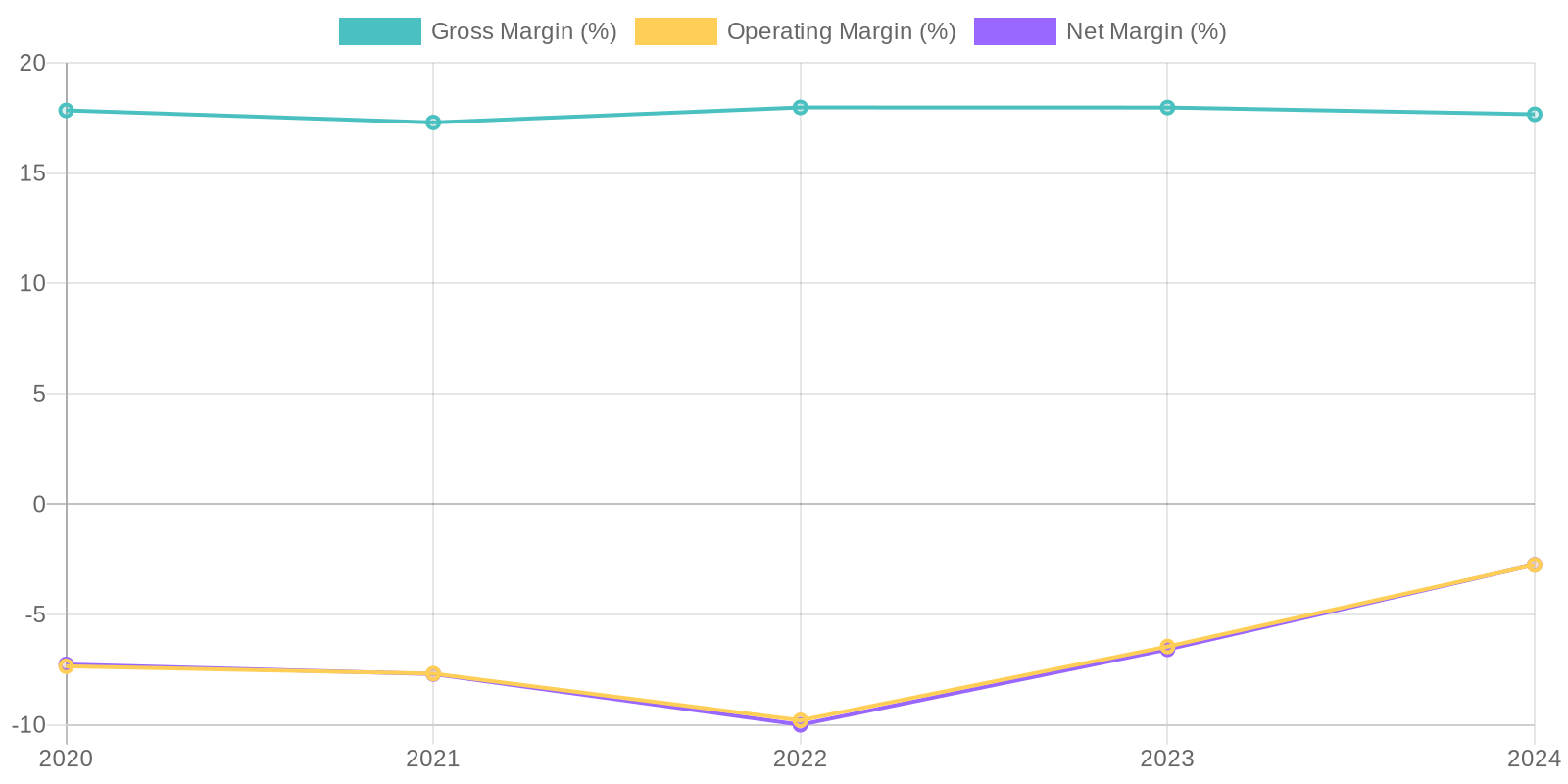 Given the company's consistent net losses, both Return on Invested Capital (ROIC) and Return on Equity (ROE) are negative, reflecting an inability to generate profits from invested capital and equity. The negative ROIC indicates that the company is not efficiently deploying capital to generate returns, which is concerning for long-term sustainability. Similarly, the negative ROE signifies that shareholders' investments are not yielding positive returns, which could deter potential investors and impact the company's ability to raise capital. Improvements in profitability and capital management are essential to improve these metrics.
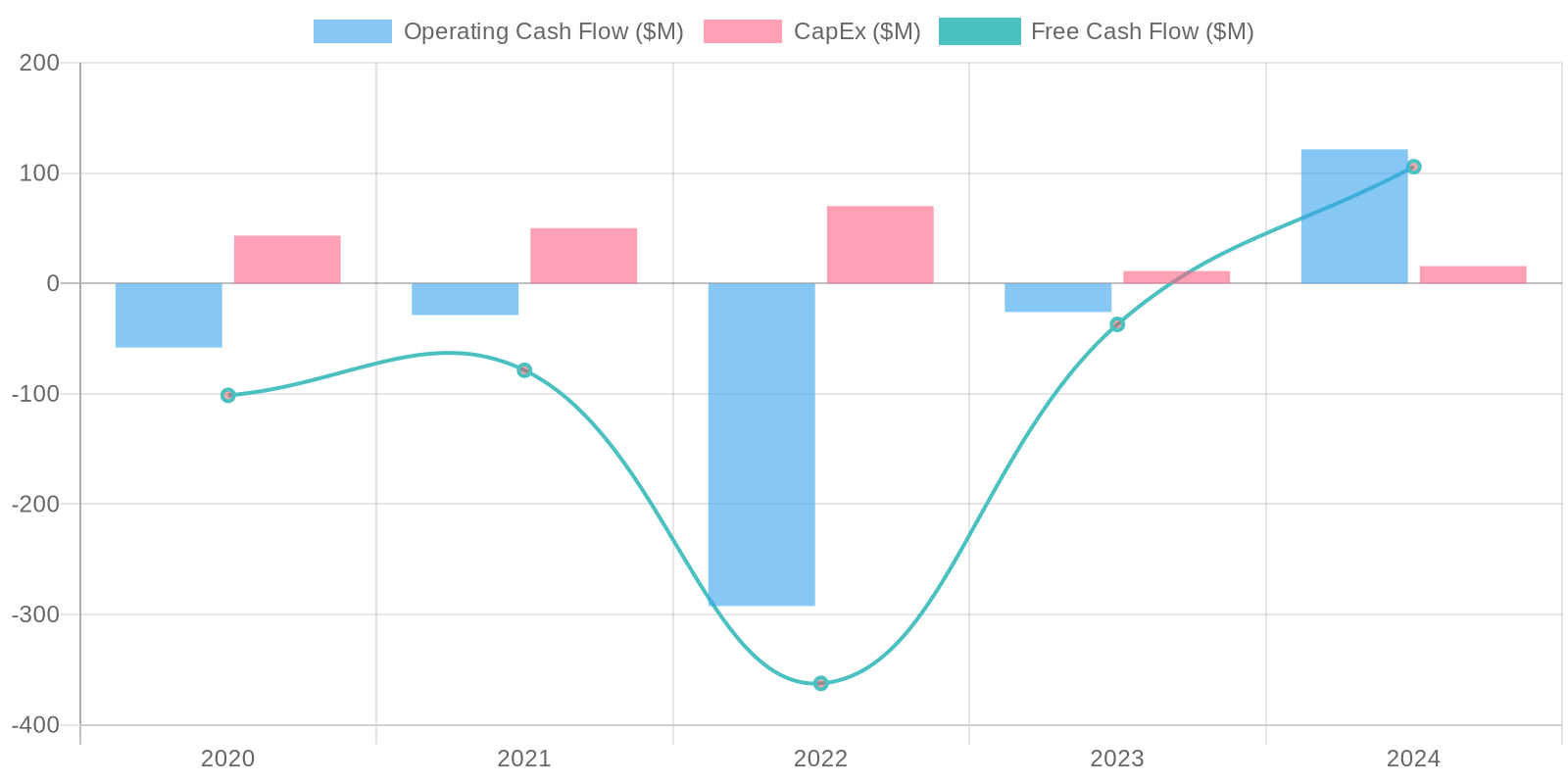 In 2024, the company generated positive free cash flow (FCF) of $105.8 million, a notable improvement compared to the negative FCF of $37.1 million in 2023 and significantly negative FCF in 2022 and 2021. The capital expenditure is relatively stable, but the company must focus on continuing to convert its revenues to free cash flow. Stock-based compensation appears to be a significant component of cash flow from operations.