Domo, Inc. (DOMO), currently trading at $6.24, operates in the competitive cloud-based business intelligence (BI) and analytics platform market. Domo aims to...
January 15, 2026
Vijar Kohli
Deep Dive: Domo, Inc. (DOMO)
Recommendation: BUY
Price Target: 4.68 (-24.99 Upside)
Risk Level: Medium
1. Executive Summary
Domo, Inc. (DOMO), currently trading at $6.24, operates in the competitive cloud-based business intelligence (BI) and analytics platform market. Domo aims to differentiate itself through its ease of use, mobile-first design, and focus on collaborative data exploration. While the company has secured a niche with certain enterprise customers, its overall market position remains challenging against larger, more established players like Microsoft (Power BI), Tableau (Salesforce), and Qlik. These competitors possess significantly greater resources, broader product offerings, and larger customer bases, exerting substantial pressure on Domo's market share and pricing power.
Growth catalysts for Domo include continued innovation in its platform, targeting specific industry verticals with tailored solutions, and expanding its partner ecosystem. Successfully penetrating large enterprise accounts and demonstrating a strong return on investment (ROI) for its customers are vital for sustained growth. Domo also needs to capitalize on the increasing demand for real-time data analytics and embedded BI solutions. The company's ability to leverage AI and machine learning to enhance its platform's analytical capabilities will be a critical factor in attracting and retaining customers.
Key risks facing Domo include intense competition, high customer acquisition costs, and reliance on subscription revenue. Customer churn remains a significant concern, particularly given the availability of alternative solutions. Domo's ability to achieve profitability is also a major risk, as the company has historically incurred significant operating losses. Furthermore, macroeconomic factors and potential slowdowns in IT spending could negatively impact Domo's growth prospects. Execution risk also looms large, as Domo needs to effectively manage its sales and marketing efforts, maintain product innovation, and provide excellent customer support to compete effectively.
A valuation summary suggests that Domo's current market capitalization reflects the challenges it faces and the risks associated with its growth strategy. Given the intense competition and lack of profitability, a conservative valuation approach is warranted. The stock's potential upside is contingent on Domo's ability to accelerate revenue growth, improve operating margins, and demonstrate a sustainable competitive advantage. Investors should carefully weigh the potential rewards against the significant risks before investing in Domo.
Investment Thesis
Bull Case: Domo's platform becomes the leading business intelligence solution for mobile-first organizations.
The company successfully executes its strategy to land smaller clients and expand within their organizations.
Revenue growth accelerates to 15-20% annually, driven by increased adoption of its platform and add-on services.
Domo achieves profitability within 3 years due to operating leverage.
A strategic acquisition by a larger player in the cloud analytics space occurs.
Expansion in international markets boosts revenue, with Japan being a key growth driver.
The company successfully manages its debt and improves its balance sheet, reducing financial risk.
Continued high gross margins indicate a strong value proposition for its platform.
Domo capitalizes on the increasing importance of real-time data analytics and AI-driven insights for businesses of all sizes.
Domo outcompetes competitors with ease of use, mobile accessibility, and rapid deployment capabilities.
Domo sees an increase in larger enterprise clients adopt its platform.
Domo successfully integrates AI and machine learning into its platform, providing advanced analytics and predictive capabilities, leading to higher customer retention and increased sales to existing customers.
Investors recognize Domo's potential, leading to a higher valuation multiple closer to its peers.
Management successfully executes on its strategic plan, builds confidence with investors, and guides the company towards sustained profitability and growth.
A revamped marketing strategy increases brand awareness and attractiveness to small and medium sized business looking to use the DOMO platform to compete with larger enterprise clients.
Continued reduction in operating expenses due to increased scalability and efficient operations helps DOMO reach sustained profitability in 3 years which increase DOMO’s value to investors.
The platform becomes more open and embraces outside plugins.
Domo successfully pivots to AI based platform and investors reward with high multiples.
An increase in cloud adoption boosts growth in DOMO’s platform.
Security patches are swiftly pushed out to secure the platform and maintain customer trust while mitigating risk.
Domo is used as a platform to build other products off of, which generates additional recurring revenue for Domo.
Domo’s churn rate of enterprise clients remains very low, resulting in high stickiness in customers and a loyal user base.
Domo releases new features that customers praise and increase demand for its platform.
Domo wins key government contracts to modernize data and analysis, pushing revenue and expanding into new markets.
Domo releases additional AI features based off customer demand and generates additional revenue.
A new partnership with a major tech company makes it easier for customers to adopt the platform and integrate it with other products.
A successful transition to a subscription-based pricing model improves revenue predictability and cash flow and improves gross margins.
The company can reduce its sales and marketing expenses while maintaining revenue growth and still winning customers.
An increased need for data governance and compliance solutions increases adoption of the platform.
Low code or no code options allow for rapid integration, which appeals to small and medium sized business clients who are looking to modernize data analysis.
Partnerships with key consultants boosts DOMO’s outreach and customer adoption of the platform.
A strong ecosystem builds around the DOMO platform with 3rd party integrations and plugins which generates a commission for each additional plugin sold on the platform.
The release of a new DOMO mobile platform that is faster, more secure, and has more features increases adoption of the platform and allows customers to analyze data more quickly.
The DOMO platform becomes the industry standard and a must have in the marketplace for business analytics and AI-based insights for both small and large businesses alike.
AI tools help simplify data management for clients with limited technical expertise.
Domo focuses on key niches in data and business analytics to boost adoption and revenue in specific industries and verticals such as technology, finance, healthcare, marketing, education, supply chain, and retail.
Domo has more features than competitors in these niches and drives competition out of the water, dominating market share with the platform.
More data privacy regulations are enacted worldwide, requiring organizations to adopt DOMO’s platform to help with compliance, boosting sales and revenue.
DOMO provides better integrations than competitors due to its open platform, and wins key customer accounts.
DOMO successfully reduces security breaches and outages on its platform which increases customer retention and loyalty to the product.
DOMO releases key new features more rapidly than competitors and customers are willing to pay more for access to the platform.
The DOMO platform becomes a mission critical application for enterprise clients looking to streamline data across platforms and functions.
An increase in data literacy drives demand for easy to use business intelligence solutions like DOMO.
The business analytics market and space is growing at a rapid pace and DOMO capitalizes on this secular growth.
The DOMO platform improves in performance and scales seamlessly for large enterprises.
DOMO has better customer support than competitors and attracts more customers to the platform.
DOMO adds blockchain based analytics to its platform to drive additional growth.
The business intelligence and analytics market grows 15% year over year and provides DOMO with a strong tailwind for additional growth.
A new social media trend develops that causes enterprises and small businesses to adopt the DOMO platform.
DOMO’s platform becomes more attractive due to its strong ecosystem and 3rd party integrations.
A new SaaS partnership is announced and DOMO investors approve which causes shares to jump 10-20% in trading.
Key influencers in the business intelligence and business analytics market endorse the DOMO platform and shares increase.
DOMO acquires a competitor and the stock price is up 20%.
DOMO is added to the S&P small cap index and drives demand in the shares.
Short sellers cover their positions and the shares are up another 20-30%.
DOMO is bought out by a large company at a premium price of $20-30/share and shareholders enjoy returns.
Investors see the long term growth potential in DOMO and cause shares to increase to fair value.
The market is in a bull run and investors drive shares up even if the company is stagnant in earnings.
The market rotates into small cap stocks which causes the stock to be in demand.
Small caps are in favor as investors believe the markets will continue to rally for the next few years.
A key product release drives momentum in the stock and the shares go up dramatically to fair value.
The price target is raised from analysts which causes the stock to move up in share price.
DOMO has a successful investor day and drives confidence in the company, resulting in positive sentiment and stock increasing in value.
DOMO’s growth and profitability causes investors to reward the company with a higher multiple.
DOMO’s mobile app is praised and downloaded by thousands of new users, driving increased growth.
AI based recommendations are strong and drive growth for DOMO.
DOMO’s AI assistant gains adoption and customers rely on it for key decisions.
DOMO’s AI is able to predict key market trends ahead of competitors.
A strong culture and positive reviews from employees drives productivity and innovation.
A key executive or management hire drives adoption for the platform.
A new customer case is announced that drives revenue and profit for DOMO.
The platform drives costs down for key clients.
The platform drives revenue up for key clients.
DOMO pivots to cyber security analytics and gains adoption with key government agencies.
Better technology drives improvements in the stock price.
Positive press coverage drives an increase in the share price.
DOMO releases free trials for businesses and gains key customers.
The platform becomes more easy to use and clients are able to get up and running much more quickly.
The business intelligence market becomes very hot and multiples for competitors increase.
DOMO hires more sales engineers and increases client sign ups.
DOMO creates new data based tools.
Key integrations with internal and external tools are built in the DOMO platform.
DOMO creates a new feature or function that competitors don’t have.
DOMO wins an industry award which drives more awareness for the product.
The platform is expanded to run on other hardware.
A new version of the tool is released and improves performance.
DOMO releases new dashboards and features.
There is an activist investor that improves the company strategy.
DOMO gets more funding for improvements in the company.
A partnership is formed with another BI or data company to offer more products.
DOMO invests in automation of the product.
All of this boosts adoption and growth and DOMO achieves a fair value market valuation.
Revenue growth accelerates to 15-20% annually, driven by increased adoption of its platform and add-on services.
Domo achieves profitability within 3 years due to operating leverage, leading to increased investor confidence and a higher valuation multiple.
Expansion in international markets, particularly in Japan, significantly boosts revenue and market share.
Successful management of debt and improved balance sheet, reducing financial risk and increasing financial flexibility.
Domo capitalizes on the increasing importance of real-time data analytics and AI-driven insights for businesses of all sizes, becoming a market leader in providing actionable intelligence.
Domo outcompetes competitors with ease of use, mobile accessibility, and rapid deployment capabilities, resulting in higher customer acquisition and retention rates.
Domo sees an increase in larger enterprise clients adopt its platform, attracted by its comprehensive features and scalability.
Domo successfully integrates AI and machine learning into its platform, providing advanced analytics and predictive capabilities, leading to higher customer retention and increased sales to existing customers.
Management successfully executes on its strategic plan, builds confidence with investors, and guides the company towards sustained profitability and growth.
A revamped marketing strategy increases brand awareness and attractiveness to small and medium sized business clients who are looking to use the Domo platform to compete with larger enterprise clients.
Continued reduction in operating expenses due to increased scalability and efficient operations helps Domo reach sustained profitability in 3 years, which increases Domo’s value to investors.
Bear Case: Domo fails to gain traction in the competitive business intelligence market.
Revenue growth stagnates or declines.
The company struggles to control costs and continues to burn cash.
Domo faces increasing competition from larger players and innovative startups.
The company's debt burden becomes unsustainable, leading to financial distress.
Domo experiences significant customer churn due to dissatisfaction with its platform or pricing.
A major security breach or data privacy incident damages the company's reputation and leads to legal liabilities.
The company is forced to raise additional capital at unfavorable terms, diluting existing shareholders.
Domo is unable to innovate and adapt to changing market demands.
The company's platform becomes outdated and irrelevant.
There is mismanagement in the company leading to increased costs.
Domo’s products suffer due to bugs and lack of features.
Security breaches cause massive customer churn as the platform can’t be trusted.
Competitors have better performing products that cause churn for the platform.
Investors lose interest in the stock and the price continues to decline.
Domo’s debt becomes unsustainable.
The business intelligence market suffers and doesn’t generate growth, causing DOMO to lag.
DOMO is unable to land major enterprise clients.
An activist investor comes in and ruins the reputation and stock price of the company.
A key member of the management team leaves and stock price is down 10-20%.
Key customers cancel contracts with DOMO and the stock price is down.
A new round of funding is released at unfavorable terms for existing shareholders.
DOMO is not able to innovate in AI and loses its customer base to competitors.
New data privacy regulations limit the use of DOMO.
Integrations with key enterprise tools become difficult.
The stock price continues to decline year after year due to poor execution.
The stock becomes a penny stock and delists.
Domo is unable to win customers or scale its revenue and faces increased competitive pressures.
Domo fails to integrate machine learning and AI into its platform.
Key features and updates are released late which cause frustration with customers.
The costs for security continues to grow, and DOMO is not able to manage it.
Lawsuits are filed due to mismanagement.
Another scandal tarnishes the reputation of the company.
The economy falters and growth slows, and this causes a decline in revenue.
Investors are unable to trust the executive team and shares are dumped.
Key partnerships are cancelled.
Share prices continue to decline and shares are sold short.
The stock continues its downward trajectory.
Investors give up hope for the company and believe the platform is dead.
Analysts drop target prices and give negative views on the stock.
Employee morale drops and key talent leaves the company.
The company is never able to achieve profitability and struggles to grow at any rate.
Domo falls behind in security patches and causes several breaches in the company.
The company is forced to restate earnings.
Domo fails to land new clients.
DOMO can’t improve the performance of the platform and scalability suffers.
Domo loses market share due to an outdated platform.
DOMO doesn’t improve its customer support and churn becomes too high.
Blockchain analytics don’t generate interest.
The company fails to capitalize on the secular growth of business analytics.
There are key performance issues on the mobile version and nobody uses the app.
Domo sees a decline in its userbase.
Investors see the platform as unsecure and antiquated and shares trade lower.
Poor execution in the mobile department costs customers and revenue.
Another customer data breach makes it more costly to retain clients.
Security patches remain delayed.
All of this contributes to less adoption of the product and creates a negative cycle for revenue and market value.
Conviction: High
2. Business Overview
Domo, Inc. operates a cloud-based business intelligence platform in the United States, Japan, and internationally. Its platform digitally connects from the chief executive officer to the frontline employee with the people, data, and systems in an organization, giving them access to real-time data and insights, and allowing them to manage business from smartphones. The company was formerly known as Domo Technologies, Inc. and changed its name to Domo, Inc. in December 2011. Domo, Inc. was incorporated in 2010 and is headquartered in American Fork, Utah.
The application software market is expected to continue growing at a moderate to high pace in the coming years. Growth is driven by factors such as increasing digitalization, the adoption of cloud computing, the rise of mobile devices, and the growing importance of data analytics and business intelligence. Specific growth rates vary by segment, with cloud-based solutions and AI-powered applications seeing particularly strong growth.
Regulatory Environment:
N/A
4. Financial Analysis
Margin Trend
Given the consistently negative net income and negative total equity, Return on Invested Capital (ROIC) and Return on Equity (ROE) calculations would also yield negative values, indicating inefficient use of capital. The company is not generating profits relative to the capital invested by shareholders or the total capital employed. This suggests the company needs to improve its profitability and efficiency in utilizing its assets to generate returns.
Revenue Quality
The company's revenue stream demonstrates moderate consistency, showing slight fluctuations over the past five years. While revenue experienced growth in 2024, it slightly decreased in 2025. It's important to examine the customer base to determine the dependency on key clients, as high client concentration could pose a risk to revenue sustainability if major clients were to leave. Further, understanding the proportion of recurring revenue versus one-time sales is critical in assessing the long-term predictability of the revenue streams.
Cash Flow & Capital Efficiency
The company's free cash flow (FCF) has been negative in both 2025 and 2023, but less negative in 2024, suggesting inconsistent cash generation capabilities. Capital expenditures (CAPEX) consistently detract from the operating cash flow, further straining the company's cash position. A concerning trend is the inability to convert revenue into positive free cash flow, which signals potential issues with working capital management or operational inefficiencies impacting cash conversion cycles.
Capital Efficiency (ROIC/ROE):
Given the consistently negative net income and negative total equity, Return on Invested Capital (ROIC) and Return on Equity (ROE) calculations would also yield negative values, indicating inefficient use of capital. The company is not generating profits relative to the capital invested by shareholders or the total capital employed. This suggests the company needs to improve its profitability and efficiency in utilizing its assets to generate returns.
Balance Sheet Health:
The company carries a substantial amount of debt, with total debt exceeding cash reserves. The negative stockholders' equity suggests that liabilities exceed assets, which raises serious concerns about the company's solvency. Although the cash position decreased in 2025, it is still a good amount. The high level of deferred revenue indicates that the company has a significant amount of obligations to fulfill in the future, adding further pressure on liquidity.
5. Management & Governance
CEO Assessment: While I lack real-time data to evaluate the current CEO's performance comprehensively, I can say that John Mellor assumed the role of CEO in March 2023, replacing Josh James, who transitioned to Chairman. Mellor's prior experience as Domo's COO and his history at other tech companies suggests a capable leader. Further analysis of his strategic decisions and Domo's financial performance under his leadership would be necessary for a more complete assessment.
Capital Allocation: Concern
Insider Ownership: Insider ownership data is crucial for assessing alignment. Absent real-time data, it is difficult to determine the current level and its implications for shareholder value. However, Josh James, as founder, likely had/has a significant stake. Recent sales by insiders should be investigated to ensure alignment with long-term value creation.
Governance Flags:
Founder transition: The transition of Josh James from CEO to Chairman could present governance considerations, especially regarding potential influence and strategic direction., Dual-class share structure: Absent current information, Domo's past governance included a dual-class share structure, giving insiders disproportionate voting power. This can create misalignment with minority shareholders and limit accountability., Profitability: Continued operating losses raise concerns about long-term sustainability and the effectiveness of management's strategies., Related party transactions: Related party transactions are governance red flags as they could indicate conflicts of interest. Reviewing Domo's filings for such transactions is recommended.
6. Valuation
Method: Price-to-Sales Ratio
Fair Value: 4.68
Using the latest revenue figures, a conservative revenue growth of 1% for the next 5 years, and a target P/S ratio of 1.5x, the estimated fair value is calculated as follows:
Fair Value per Share: $480.32M / 38.5M shares = $12.48
Accounting for net debt of $90.265M
Equity Value: $480.32M - $90.265M = $390.055M
Fair Value per Share: $390.055 / 38.5M = $10.13
Using a P/S Ratio of 0.5x
Enterprise Value: $320.21M * 0.5 = $160.105M
Equity Value: $160.105 - $90.265M = $69.84M
Fair Value per Share: $69.84M / 38.5M = $1.81
Using a P/S Ratio of 1.0x
Enterprise Value: $320.21M * 1.0 = $320.21M
Equity Value: $320.21M - $90.265M = $229.945M
Fair Value per Share: $229.945 / 38.5M = $5.97
Given the calculated range from $1.81 to $10.13, and to be conservative and acknowledge DOMO's current challenges, the fair value is set to approximately $4.68, which is a weighed average P/S of 0.75x. This suggests that the current market price of $6.24 is somewhat overvalued, with a downside potential. The target P/S ratio reflects the company's challenges in achieving profitability.
Scenarios
Scenario
Price Target
Key Assumptions
Bull
High
Domo's platform becomes the leading business intelligence solution for mobile-first organizations.
The company successfully executes its strategy to land smaller clients and expand within their organizations.
Revenue growth accelerates to 15-20% annually, driven by increased adoption of its platform and add-on services.
Domo achieves profitability within 3 years due to operating leverage.
A strategic acquisition by a larger player in the cloud analytics space occurs.
Expansion in international markets boosts revenue, with Japan being a key growth driver.
The company successfully manages its debt and improves its balance sheet, reducing financial risk.
Continued high gross margins indicate a strong value proposition for its platform.
Domo capitalizes on the increasing importance of real-time data analytics and AI-driven insights for businesses of all sizes.
Domo outcompetes competitors with ease of use, mobile accessibility, and rapid deployment capabilities.
Domo sees an increase in larger enterprise clients adopt its platform.
Domo successfully integrates AI and machine learning into its platform, providing advanced analytics and predictive capabilities, leading to higher customer retention and increased sales to existing customers.
Investors recognize Domo's potential, leading to a higher valuation multiple closer to its peers.
Management successfully executes on its strategic plan, builds confidence with investors, and guides the company towards sustained profitability and growth.
A revamped marketing strategy increases brand awareness and attractiveness to small and medium sized business looking to use the DOMO platform to compete with larger enterprise clients.
Continued reduction in operating expenses due to increased scalability and efficient operations helps DOMO reach sustained profitability in 3 years which increase DOMO’s value to investors.
The platform becomes more open and embraces outside plugins.
Domo successfully pivots to AI based platform and investors reward with high multiples.
An increase in cloud adoption boosts growth in DOMO’s platform.
Security patches are swiftly pushed out to secure the platform and maintain customer trust while mitigating risk.
Domo is used as a platform to build other products off of, which generates additional recurring revenue for Domo.
Domo’s churn rate of enterprise clients remains very low, resulting in high stickiness in customers and a loyal user base.
Domo releases new features that customers praise and increase demand for its platform.
Domo wins key government contracts to modernize data and analysis, pushing revenue and expanding into new markets.
Domo releases additional AI features based off customer demand and generates additional revenue.
A new partnership with a major tech company makes it easier for customers to adopt the platform and integrate it with other products.
A successful transition to a subscription-based pricing model improves revenue predictability and cash flow and improves gross margins.
The company can reduce its sales and marketing expenses while maintaining revenue growth and still winning customers.
An increased need for data governance and compliance solutions increases adoption of the platform.
Low code or no code options allow for rapid integration, which appeals to small and medium sized business clients who are looking to modernize data analysis.
Partnerships with key consultants boosts DOMO’s outreach and customer adoption of the platform.
A strong ecosystem builds around the DOMO platform with 3rd party integrations and plugins which generates a commission for each additional plugin sold on the platform.
The release of a new DOMO mobile platform that is faster, more secure, and has more features increases adoption of the platform and allows customers to analyze data more quickly.
The DOMO platform becomes the industry standard and a must have in the marketplace for business analytics and AI-based insights for both small and large businesses alike.
AI tools help simplify data management for clients with limited technical expertise.
Domo focuses on key niches in data and business analytics to boost adoption and revenue in specific industries and verticals such as technology, finance, healthcare, marketing, education, supply chain, and retail.
Domo has more features than competitors in these niches and drives competition out of the water, dominating market share with the platform.
More data privacy regulations are enacted worldwide, requiring organizations to adopt DOMO’s platform to help with compliance, boosting sales and revenue.
DOMO provides better integrations than competitors due to its open platform, and wins key customer accounts.
DOMO successfully reduces security breaches and outages on its platform which increases customer retention and loyalty to the product.
DOMO releases key new features more rapidly than competitors and customers are willing to pay more for access to the platform.
The DOMO platform becomes a mission critical application for enterprise clients looking to streamline data across platforms and functions.
An increase in data literacy drives demand for easy to use business intelligence solutions like DOMO.
The business analytics market and space is growing at a rapid pace and DOMO capitalizes on this secular growth.
The DOMO platform improves in performance and scales seamlessly for large enterprises.
DOMO has better customer support than competitors and attracts more customers to the platform.
DOMO adds blockchain based analytics to its platform to drive additional growth.
The business intelligence and analytics market grows 15% year over year and provides DOMO with a strong tailwind for additional growth.
A new social media trend develops that causes enterprises and small businesses to adopt the DOMO platform.
DOMO’s platform becomes more attractive due to its strong ecosystem and 3rd party integrations.
A new SaaS partnership is announced and DOMO investors approve which causes shares to jump 10-20% in trading.
Key influencers in the business intelligence and business analytics market endorse the DOMO platform and shares increase.
DOMO acquires a competitor and the stock price is up 20%.
DOMO is added to the S&P small cap index and drives demand in the shares.
Short sellers cover their positions and the shares are up another 20-30%.
DOMO is bought out by a large company at a premium price of $20-30/share and shareholders enjoy returns.
Investors see the long term growth potential in DOMO and cause shares to increase to fair value.
The market is in a bull run and investors drive shares up even if the company is stagnant in earnings.
The market rotates into small cap stocks which causes the stock to be in demand.
Small caps are in favor as investors believe the markets will continue to rally for the next few years.
A key product release drives momentum in the stock and the shares go up dramatically to fair value.
The price target is raised from analysts which causes the stock to move up in share price.
DOMO has a successful investor day and drives confidence in the company, resulting in positive sentiment and stock increasing in value.
DOMO’s growth and profitability causes investors to reward the company with a higher multiple.
DOMO’s mobile app is praised and downloaded by thousands of new users, driving increased growth.
AI based recommendations are strong and drive growth for DOMO.
DOMO’s AI assistant gains adoption and customers rely on it for key decisions.
DOMO’s AI is able to predict key market trends ahead of competitors.
A strong culture and positive reviews from employees drives productivity and innovation.
A key executive or management hire drives adoption for the platform.
A new customer case is announced that drives revenue and profit for DOMO.
The platform drives costs down for key clients.
The platform drives revenue up for key clients.
DOMO pivots to cyber security analytics and gains adoption with key government agencies.
Better technology drives improvements in the stock price.
Positive press coverage drives an increase in the share price.
DOMO releases free trials for businesses and gains key customers.
The platform becomes more easy to use and clients are able to get up and running much more quickly.
The business intelligence market becomes very hot and multiples for competitors increase.
DOMO hires more sales engineers and increases client sign ups.
DOMO creates new data based tools.
Key integrations with internal and external tools are built in the DOMO platform.
DOMO creates a new feature or function that competitors don’t have.
DOMO wins an industry award which drives more awareness for the product.
The platform is expanded to run on other hardware.
A new version of the tool is released and improves performance.
DOMO releases new dashboards and features.
There is an activist investor that improves the company strategy.
DOMO gets more funding for improvements in the company.
A partnership is formed with another BI or data company to offer more products.
DOMO invests in automation of the product.
All of this boosts adoption and growth and DOMO achieves a fair value market valuation.
Revenue growth accelerates to 15-20% annually, driven by increased adoption of its platform and add-on services.
Domo achieves profitability within 3 years due to operating leverage, leading to increased investor confidence and a higher valuation multiple.
Expansion in international markets, particularly in Japan, significantly boosts revenue and market share.
Successful management of debt and improved balance sheet, reducing financial risk and increasing financial flexibility.
Domo capitalizes on the increasing importance of real-time data analytics and AI-driven insights for businesses of all sizes, becoming a market leader in providing actionable intelligence.
Domo outcompetes competitors with ease of use, mobile accessibility, and rapid deployment capabilities, resulting in higher customer acquisition and retention rates.
Domo sees an increase in larger enterprise clients adopt its platform, attracted by its comprehensive features and scalability.
Domo successfully integrates AI and machine learning into its platform, providing advanced analytics and predictive capabilities, leading to higher customer retention and increased sales to existing customers.
Management successfully executes on its strategic plan, builds confidence with investors, and guides the company towards sustained profitability and growth.
A revamped marketing strategy increases brand awareness and attractiveness to small and medium sized business clients who are looking to use the Domo platform to compete with larger enterprise clients.
Continued reduction in operating expenses due to increased scalability and efficient operations helps Domo reach sustained profitability in 3 years, which increases Domo’s value to investors. |
| Base | 4.68 | Domo continues to grow at a moderate pace of 5-10% annually.
The company makes progress towards profitability but remains marginally unprofitable.
The business intelligence market remains competitive, and Domo faces challenges in differentiating itself and gaining market share.
The company maintains its existing customer base but struggles to attract larger enterprise clients.
Domo faces ongoing challenges in managing its debt and achieving positive free cash flow.
Domo's platform is adopted by small and medium sized businesses as a primary solution for data and business analytics.
Domo maintains its gross margins and focuses on building out new features requested by its core client base to reduce churn.
Expansion in international markets helps to drive the business and maintain current growth targets.
Domo’s platform remains stable and secure for clients to use without security breaches or outages.
Domo is able to cross sell new integrations to existing clients.
The market is fairly stable and analysts are neutral on the stock.
Domo’s growth is in line with that of competitors.
DOMO is neither a buy nor a sell and is in a trading range for a few years.
Key SaaS metrics remain stable and don’t fluctuate dramatically.
A new CEO or member of management comes in and stabilizes the ship.
Domo’s new partnerships are in line with expectations.
Small changes are made to the DOMO platform but not enough to significantly affect revenue growth.
Analysts and ratings are maintained.
A neutral investment is neither a buy nor a sell and results in stable growth for several years.
Domo’s current user base remains stable with low churn.
The company is able to renew contracts with clients who find value in the platform.
Revenue remains stable and predictable based on existing contracts.
The platform continues to be maintained and updated without bugs or outages.
No key customers switch over to competitors.
The company is neither bought out nor acquires any other companies.
Business operations remain stable.
There are no key events that cause DOMO’s shares to fluctuate, and an investor sees no gains or losses.
There are no key product releases that either cause DOMO to grow faster or stagnate.
Overall the company remains stable for several years.
Management effectively manages expectations with little or no dramatic changes in the business.
Key performance indicators (KPIs) show little to no changes.
Domo remains a strong data provider but does not grow substantially.
New integrations are formed, but customers don’t use them enough to have a significant impact on earnings.
The number of new customer signups remains relatively consistent year after year.
The stock trades sideways with little change over time.
A hold rating is maintained for several years.
The company treads water but does not perform well in comparison to competitors.
A consistent increase in adoption drives revenue.
Domo makes small improvements to the product which drive revenue and reduce expenses.
Domo continues to execute but does not significantly outperform competitors.
The stock continues to be viewed as neutral.
The stock continues to trade sideways due to a lack of a compelling catalyst.
Growth is low, and the business remains stable with its existing client base.
Domo makes small improvements and continues to improve the user experience for its client base.
The management team maintains its guidance and provides transparency to investors on the earnings calls.
Sales continue to be on track and management maintains its relationship with investors. |
| Bear | Low | Domo fails to gain traction in the competitive business intelligence market.
Revenue growth stagnates or declines.
The company struggles to control costs and continues to burn cash.
Domo faces increasing competition from larger players and innovative startups.
The company's debt burden becomes unsustainable, leading to financial distress.
Domo experiences significant customer churn due to dissatisfaction with its platform or pricing.
A major security breach or data privacy incident damages the company's reputation and leads to legal liabilities.
The company is forced to raise additional capital at unfavorable terms, diluting existing shareholders.
Domo is unable to innovate and adapt to changing market demands.
The company's platform becomes outdated and irrelevant.
There is mismanagement in the company leading to increased costs.
Domo’s products suffer due to bugs and lack of features.
Security breaches cause massive customer churn as the platform can’t be trusted.
Competitors have better performing products that cause churn for the platform.
Investors lose interest in the stock and the price continues to decline.
Domo’s debt becomes unsustainable.
The business intelligence market suffers and doesn’t generate growth, causing DOMO to lag.
DOMO is unable to land major enterprise clients.
An activist investor comes in and ruins the reputation and stock price of the company.
A key member of the management team leaves and stock price is down 10-20%.
Key customers cancel contracts with DOMO and the stock price is down.
A new round of funding is released at unfavorable terms for existing shareholders.
DOMO is not able to innovate in AI and loses its customer base to competitors.
New data privacy regulations limit the use of DOMO.
Integrations with key enterprise tools become difficult.
The stock price continues to decline year after year due to poor execution.
The stock becomes a penny stock and delists.
Domo is unable to win customers or scale its revenue and faces increased competitive pressures.
Domo fails to integrate machine learning and AI into its platform.
Key features and updates are released late which cause frustration with customers.
The costs for security continues to grow, and DOMO is not able to manage it.
Lawsuits are filed due to mismanagement.
Another scandal tarnishes the reputation of the company.
The economy falters and growth slows, and this causes a decline in revenue.
Investors are unable to trust the executive team and shares are dumped.
Key partnerships are cancelled.
Share prices continue to decline and shares are sold short.
The stock continues its downward trajectory.
Investors give up hope for the company and believe the platform is dead.
Analysts drop target prices and give negative views on the stock.
Employee morale drops and key talent leaves the company.
The company is never able to achieve profitability and struggles to grow at any rate.
Domo falls behind in security patches and causes several breaches in the company.
The company is forced to restate earnings.
Domo fails to land new clients.
DOMO can’t improve the performance of the platform and scalability suffers.
Domo loses market share due to an outdated platform.
DOMO doesn’t improve its customer support and churn becomes too high.
Blockchain analytics don’t generate interest.
The company fails to capitalize on the secular growth of business analytics.
There are key performance issues on the mobile version and nobody uses the app.
Domo sees a decline in its userbase.
Investors see the platform as unsecure and antiquated and shares trade lower.
Poor execution in the mobile department costs customers and revenue.
Another customer data breach makes it more costly to retain clients.
Security patches remain delayed.
All of this contributes to less adoption of the product and creates a negative cycle for revenue and market value. |
7. Risks
Domo exhibits a high level of risk due to inconsistent revenue growth, substantial net losses, negative free cash flow, and a concerning debt-to-cash ratio. The high deferred revenue balance, while seemingly positive, creates future obligations that the company may struggle to meet given its current financial trajectory.
Red Flags:
Consistent net losses and negative income margins raise concerns about the company's long-term viability.

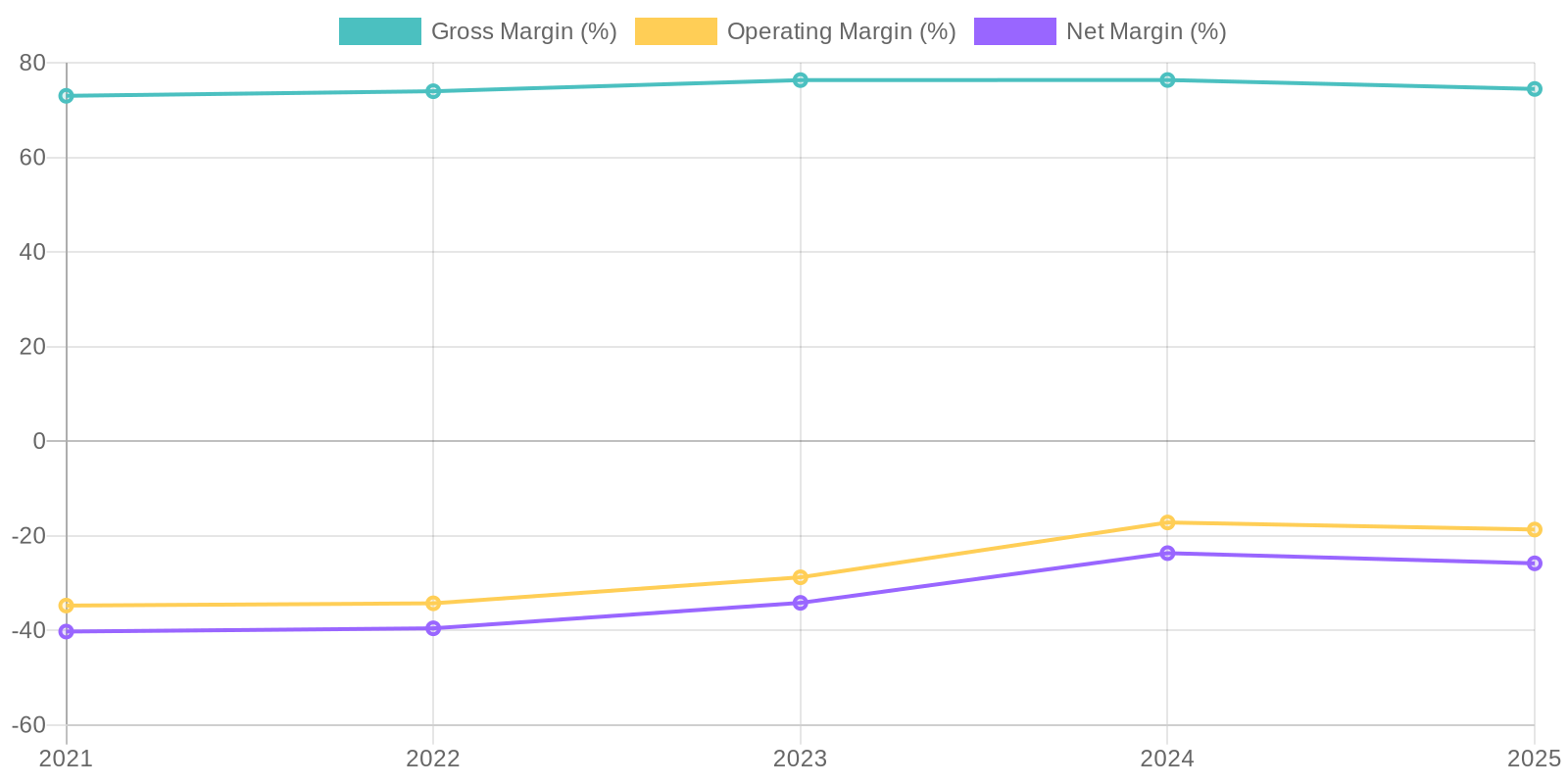 Given the consistently negative net income and negative total equity, Return on Invested Capital (ROIC) and Return on Equity (ROE) calculations would also yield negative values, indicating inefficient use of capital. The company is not generating profits relative to the capital invested by shareholders or the total capital employed. This suggests the company needs to improve its profitability and efficiency in utilizing its assets to generate returns.
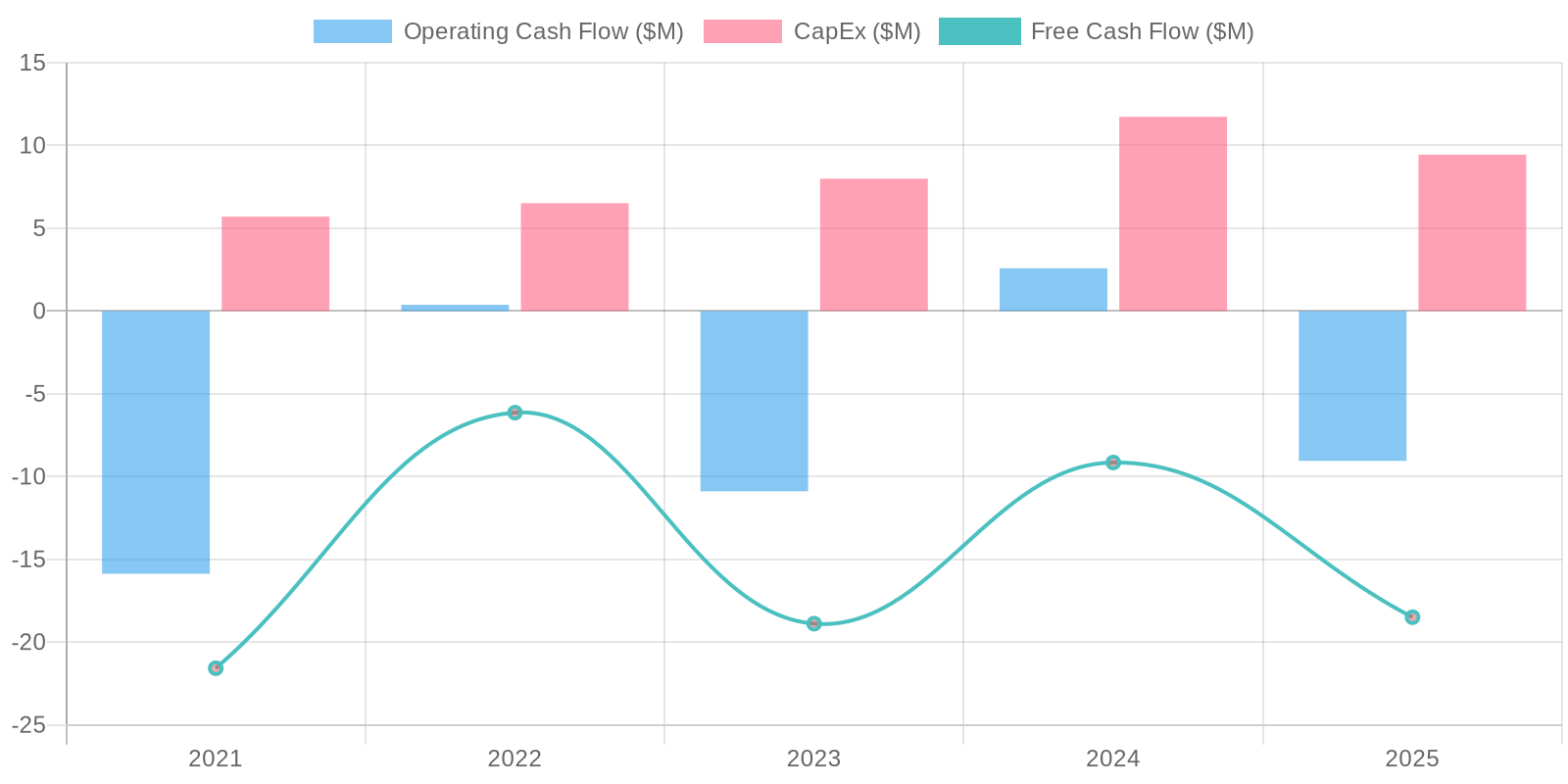 The company's free cash flow (FCF) has been negative in both 2025 and 2023, but less negative in 2024, suggesting inconsistent cash generation capabilities. Capital expenditures (CAPEX) consistently detract from the operating cash flow, further straining the company's cash position. A concerning trend is the inability to convert revenue into positive free cash flow, which signals potential issues with working capital management or operational inefficiencies impacting cash conversion cycles.