
Golden Door Asset · Investment Committee Research Brief
Industry
Published Nov 20, 2026 · Data as of Nov 20, 2026
Industry · Research
Agents Merged the Database Bill, Not the Database
Snowflake (SNOW), Databricks and Alphabet (GOOG) each shipped the other half of the data stack in 2026, yet every one of those products still keeps a row store and a column store side by side. What actually merged is the bill: new agent workloads can now draw down a warehouse or Atlas commitment that is already signed, which makes the commitment, not the storage engine, the prize in the fight between Snowflake, MongoDB (MDB), Alphabet, Oracle (ORCL) and Teradata (TDC).
On Nov 4, 2026, Google, a unit of Alphabet (GOOG), added direct reads of Iceberg lakehouse tables to AlloyDB, its Postgres-compatible operational database, in preview, and made BigQuery federation and scheduled BigQuery-to-AlloyDB sync generally available [1]. That launch is the latest in a 2026 wave in which warehouse vendors shipped a transactional database and operational-database vendors shipped a way to scan history, changing the job of giving a superintelligence agent live state and historical context in one place [1][3][6][8][13].
The wave hits the covered data-platform niche, Snowflake (SNOW), MongoDB (MDB) and Teradata (TDC), and also Alphabet and Oracle (ORCL) [17]. Alphabet's Google Cloud unit now sells both halves as separate products.
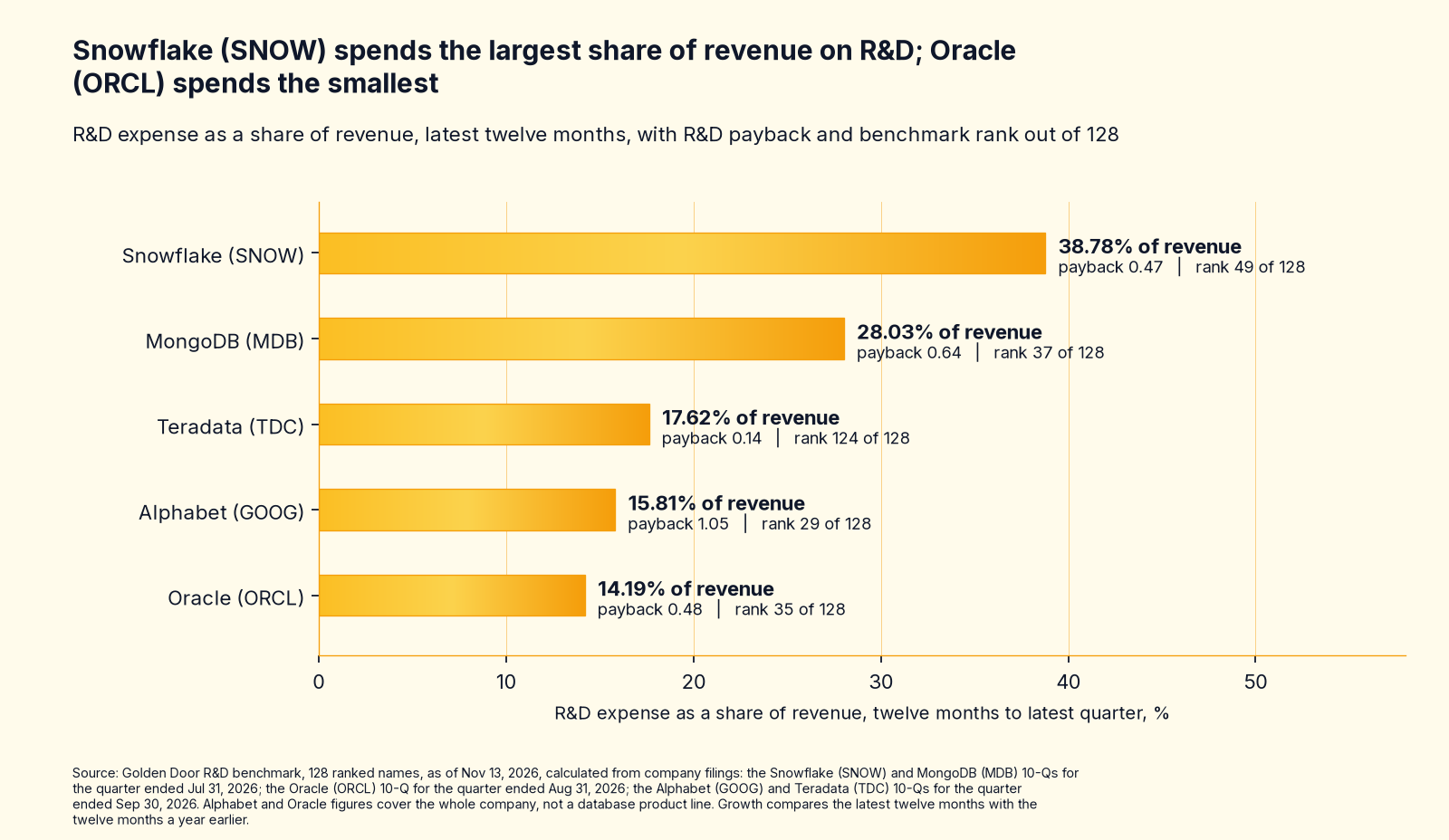
Oracle already sold live state and analytics on one database, and on Oct 26, 2026 it made Oracle AI Database Agent Engine generally available inside that engine [26][17]. That matters for readers of the R&D benchmark because the new agent workloads draw down commitments those companies already hold, so the contest is over which invoice the agent lands on, not over who invented a single storage engine [13][15][26].
An agent decision needs live state and history in the same query
A superintelligence agent that approves a payment, prices an item or answers a customer has to read two kinds of data before it acts. It needs the current row (the open cart, the account balance, the last ticket) and it needs years of history to judge that row.
Google, a unit of Alphabet (GOOG), framed its Nov 4, 2026 AlloyDB launch in exactly those terms: operational databases hold "the live state of the business" while warehouses and lakehouses hold "the historical context" [1].
Those two needs have lived in two systems for decades. Transactional databases (OLTP) store data row by row so that single records can be written and locked in milliseconds.
Analytical warehouses (OLAP) store data column by column so that billions of rows can be scanned and summed. Moving data from the first to the second is the extract, transform and load (ETL) pipeline that every vendor now promises to remove.
Agents also create databases at a pace no human team does. When Databricks agreed to buy Neon in May 2025, it disclosed that over 80 percent of the databases provisioned on Neon were created automatically by agents rather than by people [2].
That telemetry is the demand signal behind the 2026 product wave.
Companies Referenced in This Research
Related Coverage & Peer Deep-Dives
View All →Alphabet's Gemini 4 Stack: Why Neon Rewrites Frontier Software Economics
With Gemini 4 Neon scoring 61 on the Artificial Analysis Index at $3.00 input and $15.00 output per million tokens, Alphabet undercuts its own flagship Carbon tier by 25.0% while collapsing four releases into a unified three-tier software stack.