Golden Door Asset
BenchmarkResearchFinancials
Sign InFull Access

Golden Door Asset

Public software investment firm focused on durable compounders, supported by our software quality ratings and research.

Ratings & Research

  • Research Library
  • R&D Benchmark
  • Methodology
  • Financial Model
  • Investment Mandate
  • Full Access

Company

  • About Us
  • Member Hub
  • Member Sign In
  • Contact Us

Legal

  • Privacy
  • Terms
© 2026 Golden Door Asset. All rights reserved.
Loading equity research...

Golden Door Asset · Investment Committee Research Brief

Industry

Published Nov 21, 2026 · Data as of Nov 21, 2026

Research Library/Industry

Industry · Research

Clouds Own the Servers. Database Renters Kept the Margin.

By Vijar Kohli

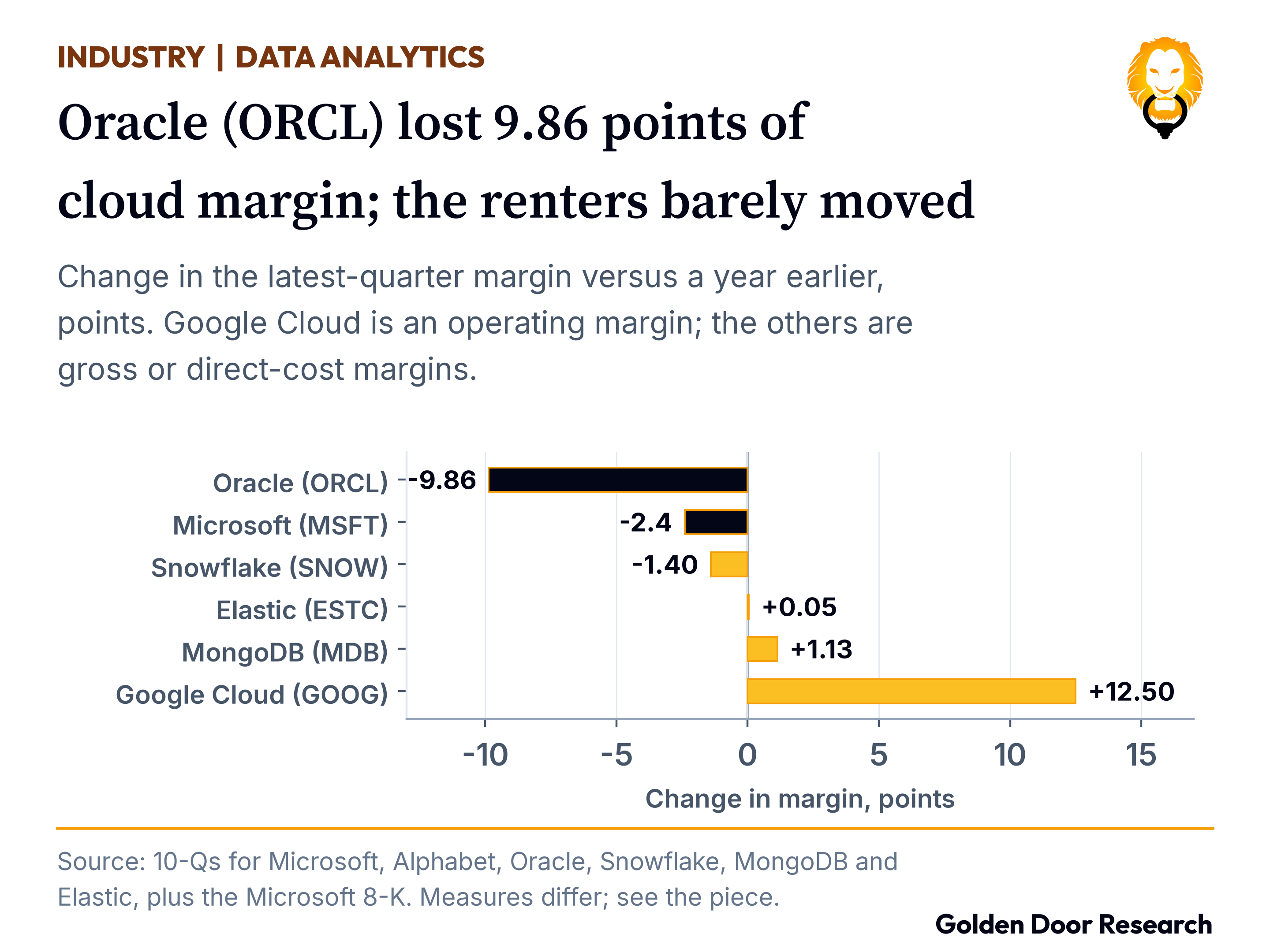
Microsoft (MSFT) and Oracle (ORCL) lost between 2.4 and 9.86 points of cloud margin in their latest quarter as new data center capacity came online, while Snowflake (SNOW), MongoDB (MDB) and Elastic (ESTC) held gross margins of roughly 71% to 77% on infrastructure they rent from those same clouds. Owning servers turns every new data center into depreciation that lands before the revenue does; renting turns it into a usage bill that grows with the customer.
ResearchPublished Nov 21, 2026 · Data as of Nov 21, 2026· 2 min read · 1 exhibit
Change in latest-quarter margin versus a year earlier, in points: Oracle (ORCL) -9.86, Microsoft (MSFT) -2.4, Snowflake (SNOW) -1.40, Elastic (ESTC) +0.05, MongoDB (MDB) +1.13, and Google Cloud (GOOG) +12.50. Google Cloud is an operating margin; the others are gross or direct-cost margins.
Exhibit 1. Oracle (ORCL) and Microsoft (MSFT) lost cloud margin as new capacity came online; the three database renters barely moved.

The latest quarterly filings from Oracle (ORCL), Microsoft (MSFT), Alphabet (GOOG) and Elastic (ESTC), the last of them the Elastic 10-Q for the quarter ended Oct 31, 2026 filed on Nov 20, 2026, show how a wave of new data center capacity moved through the income statements of the companies that own the servers and the database vendors that rent them [4][9][10][1]. That split lands on the covered data-analytics niche, Snowflake (SNOW), MongoDB (MDB) and Elastic, and on the three clouds those vendors buy from [2][3][4].

Readers of the R&D benchmark should care because the renters' higher gross margins are what fund research bills of 25.26% to 38.78% of revenue, more than twice the owners' share [13].

Owning moves the cost into depreciation, renting moves it into a monthly bill

A database company has two ways to pay for the servers, memory and disks its customers use. It can build and run them in its own data centers, as Alphabet (GOOG), Microsoft (MSFT) and Oracle (ORCL) do, or it can rent them from those clouds, as Snowflake (SNOW), MongoDB (MDB) and Elastic (ESTC) do.

The choice decides which line of the income statement absorbs the hardware.

Alphabet's cost of revenues includes depreciation "primarily related to our technical infrastructure," plus energy, equipment and network capacity, according to the Alphabet 10-Q for the quarter ended Sep 30, 2026 [1]. Snowflake's cost of product revenue consists primarily of third-party cloud infrastructure expenses, including those related to superintelligence inference and GPUs, according to the Snowflake 10-Q for the quarter ended Jul 31, 2026 [2].

MongoDB says the same of its subscription costs in the MongoDB 10-Q for the quarter ended Jul 31, 2026, and Elastic lists cloud hosting first among its subscription costs in the latest 10-Q [3][4].

The difference is timing. An owner records depreciation from the day a server goes live, whether or not it is full.

A renter pays roughly in step with usage, at prices set by contracts it signs with the owner.

On this page

  1. Owning moves the cost into depreciation, renting moves it into a monthly bill
  2. A gigabyte in memory costs about 132 times the same gigabyte in object storage
  3. Microsoft (MSFT) and Oracle (ORCL) lost cloud margin as new capacity came online
  4. Google Cloud's operating margin rose because payroll did not keep up with revenue
  5. Snowflake (SNOW), MongoDB (MDB) and Elastic (ESTC) held gross margins near 71% to 77%
  6. Superintelligence inference is the first cost pressing on the renters
  7. Long purchase contracts turn the owners' fixed cost into a known bill for the renters
  8. The renters spend more than twice the owners' share of revenue on R&D
  9. The next filings will show whether new capacity fills and whether inference costs scale
Unlock the full note with Full Access

$1,000/yr. The full notes, valuation, exhibits, risks, archive and exports across 130 stocks.

Full Access

Golden Door Membership

Unlock the full institutional underwriting, Bear/Base/Bull valuation cases, exhibits, and permanent research archive across 130 software companies.

Remaining in this report (8 sections)+5 exhibits
  1. 1.A gigabyte in memory costs about 132 times the same gigabyte in object storage
  2. 2.Microsoft (MSFT) and Oracle (ORCL) lost cloud margin as new capacity came online
  3. 3.Google Cloud's operating margin rose because payroll did not keep up with revenue
  4. 4.Snowflake (SNOW), MongoDB (MDB) and Elastic (ESTC) held gross margins near 71% to 77%
  5. 5.Superintelligence inference is the first cost pressing on the renters

Sources

  1. [1]Alphabet 10-Q for the quarter ended Sep 30, 2026.
  2. [2]Snowflake 10-Q for the quarter ended Jul 31, 2026.
  3. [3]MongoDB 10-Q for the quarter ended Jul 31, 2026.
  4. [4]Elastic 10-Q for the quarter ended Oct 31, 2026, filed Nov 20, 2026.
  5. [5]Azure Retail Prices API, East US, Linux, Consumption, retrieved Nov 20, 2026.
  6. [6]Microsoft Learn VM size pages for the Dsv5, Esv5, Lsv3 and ND H100 v5 series.

Companies Referenced in This Research

MSFTMicrosoft CorporationORCLOracle CorporationSNOWSnowflake Inc.MDBMongoDB, Inc.ESTCElastic N.V.GOOGAlphabet

Related Coverage & Peer Deep-Dives

View All →
GOOG56.51 · NeutralMentioned in Report
Free summary

Alphabet's Gemini 4 Stack: Why Neon Rewrites Frontier Software Economics

With Gemini 4 Neon scoring 61 on the Artificial Analysis Index at $3.00 input and $15.00 output per million tokens, Alphabet undercuts its own flagship Carbon tier by 25.0% while collapsing four releases into a unified three-tier software stack.

AlphabetNov 19, 2026 · Data as of Nov 18, 2026
← All Research Library
Explore Software Ratings & Research →
6.
Long purchase contracts turn the owners' fixed cost into a known bill for the renters
  • 7.The renters spend more than twice the owners' share of revenue on R&D
  • 8.The next filings will show whether new capacity fills and whether inference costs scale
  • Locked analytical exhibits (5)

    Owner Cash Waterfall & 5x5 Sensitivity Matrix
    Owner Cash Waterfall
    5x5 Sensitivity Matrix
    Bear/Base/Bull Valuation & RisksAll Exhibits & Financial Schedules130-Stock Archive & CSV Exports
    Get Full Access→
    Instant web & archive accessMember Sign In

    Not ready yet? Get the free opening of each weekly research note by email.

  • [7]AWS Price List API, Amazon S3, us-east-1, publication 2026-11-20.
  • [8]Snowflake documentation, hybrid tables.
  • [9]Microsoft 10-Q for the quarter ended Sep 30, 2026.
  • [10]Oracle 10-Q for the quarter ended Aug 31, 2026.
  • [11]Alphabet 8-K Exhibit 99.1, Q3 2026 earnings release.
  • [12]Elastic 10-Q for the quarter ended Jul 31, 2026.
  • [13]Golden Door R&D benchmark, 128 ranked names, as of Nov 13, 2026, calculated from each company's latest 10-Q then on file.
  • [14]Microsoft 8-K Exhibit 99.1, Oct 28, 2026 earnings release.
  • [15]Oracle 8-K Exhibit 99.1, Sep 10, 2026 earnings release.
  • [16]MongoDB news release, Nov 5, 2026, announcing Dec 1, 2026 results.
  • [17]Snowflake news release, Nov 2, 2026, announcing Dec 2, 2026 results.
  • [18]Oracle news release, Dec 10, 2025, results for the quarter ended Nov 30, 2025 (year-earlier date for the next report).
  • [19]Microsoft 8-K, Jan 28, 2026, results for the quarter ended Dec 31, 2025 (year-earlier date for the next report).
  • [20]Alphabet news release, Jan 8, 2026, setting the year-earlier call for Feb 4, 2026.
  • SNOW45.35 · NeutralMentioned in Report
    Free summary

    Snowflake: Catalog Openness Versus Negative Owner Cash After Stock Pay

    Snowflake grows trailing revenue 32.04% to $5.43B with Apache Polaris countering Databricks Unity Catalog, yet $1.64B in stock pay keeps owner cash at -$446.65M ahead of Q3 FY2027.

    Snowflake Inc.Nov 18, 2026 · Data as of Nov 18, 2026
    MSFT67.13 · StrongMentioned in Report
    Free summary

    Claude Sheets Still Sends Serious Work Back to Excel, but Microsoft's Owner Cash Fell 46.64% in Two Years and Its Market Value Assumes 57% Yearly Growth

    Anthropic's new sheets still send serious work back to Excel, but owner cash after capex and stock pay fell 46.64% in two years and the market value assumes about 57% yearly growth.

    Microsoft CorporationNov 14, 2026 · Data as of Nov 14, 2026
    GOOG56.51 · NeutralMentioned in Report
    Free summary

    Gemini 4 Argon Doubles Its Price on December 1, and That Is the First Real Test of Whether Alphabet's $132 Billion Build Pays Back

    Gemini 4 Argon went on sale after the quarter closed, so none of its revenue is in the filings. Owner cash is still negative $10.7B over twelve months, and Alphabet priced six billion euros of new bonds on Nov 2.

    AlphabetNov 3, 2026 · Data as of Nov 3, 2026