
Golden Door Asset · Investment Committee Research Brief
Veeva Systems
Published Oct 31, 2026 · Data as of Oct 31, 2026
VEEV · Research
Veeva Owns the Regulated Records Drug Agents Must Write To, but Salesforce Is Fighting It for the Sales Desk
Veeva holds the validated clinical, safety and quality records of drug development and kept $1.14B for owners after stock pay over the last year, but its move off the Salesforce platform has opened its CRM business to Salesforce.
- Owner cash after all capex and stock pay
- $1.14B
- Stock pay as a share of operating cash flow
- 30%
- Top 20 drugmakers committed to Vault CRM
- 12 of 20
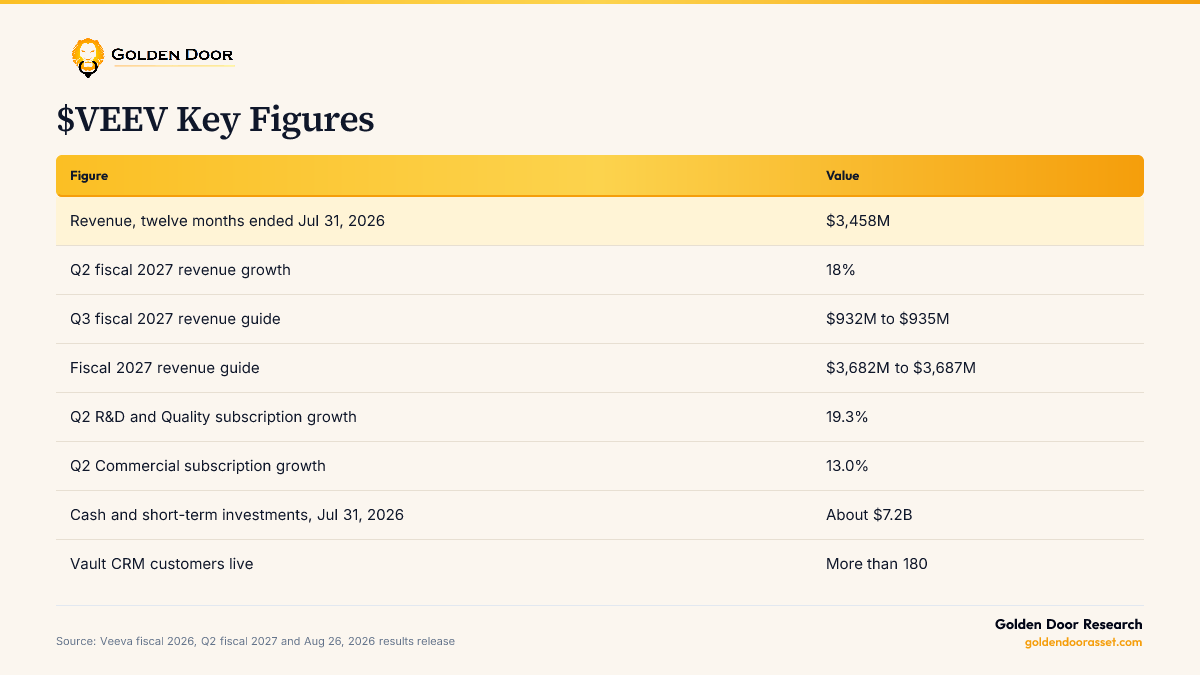
$3,458M
| Figure | Value |
|---|---|
| Revenue, twelve months ended Jul 31, 2026 | $3,458M |
| Q2 fiscal 2027 revenue growth | 18% |
| Q3 fiscal 2027 revenue guide | $932M to $935M |
| Fiscal 2027 revenue guide | $3,682M to $3,687M |
| Q2 R&D and Quality subscription growth | 19.3% |
| Q2 Commercial subscription growth | 13.0% |
| Cash and short-term investments, Jul 31, 2026 | About $7.2B |
| Vault CRM customers live | More than 180 |
Source: Veeva fiscal 2026, Q2 fiscal 2027 and Aug 26, 2026 results release
Golden Door Researchgoldendoorasset.com
$VEEV key figures, latest filings.
1. Our call: Buy the strongest owner of regulated records we have tested
Our call: Buy. Veeva owns the regulated records of drug development.
Clinical trial files, regulatory submissions, safety cases and quality documents for most large drugmakers live in its Vault applications, and those records must meet validation rules that regulators inspect [1]. Any agent that prepares a submission, triages an adverse event or checks a batch record has to write into a validated system, and Veeva is that system for much of the industry.
Owners are well paid. Owner cash, meaning operating cash flow of $1,665M less $27M of capital spending less $495M of stock pay, was $1,144M for the twelve months ended Jul 31, 2026, our calculation, and it has been positive in every fiscal year we track [2][12].
On the clinical side the 10-K says no single company offers products that compete with all of its Development Cloud or Quality Cloud applications, though IQVIA, Dassault Systemes, OpenText, Oracle and others compete with some of them [1]. The CRM risk sits in commercial work, which is 45% of subscription revenue, our calculation, while the larger research and quality side grows faster [2].
We would move to Hold off if commercial subscription growth falls below 10%, or if a top 20 drugmaker goes back to Salesforce for CRM.
The open question is the sales desk. Veeva built its original CRM for drug sales teams on the Salesforce platform and is now moving every customer to Vault CRM on its own platform, with the old product supported until Dec 31, 2029 [2].
Salesforce has launched a competing life sciences CRM, has licensed IQVIA's CRM software, and has announced that certain large Veeva CRM customers committed to it [2]. Twelve of the top 20 drugmakers have committed to Vault CRM; the others are either undecided or leaving [3].
The question this piece answers is whether Veeva's hold on regulated records lets it charge for the agents that will do clinical, regulatory and safety work, and whether that offsets what it may lose in commercial CRM. Our view: the record is the strongest we have tested in this series and the cash is real; the commercial side, growing at 13% while the CRM switch plays out, is the part to watch, not the reason to wait [2][3].
$1,000/yr. The full notes, valuation, exhibits, risks, archive and exports across 130 stocks.
Companies Referenced in This Research
VEEV Stock Profile →Related Coverage & Peer Deep-Dives
View All →Intuit (INTU) Sells Mailchimp to Refocus on the Ledger and the Tax Return
Intuit (INTU) is selling Mailchimp to Bending Spoons (BSP) so it can win customers from inside the small-business ledger, payroll and the tax return, through what it calls lead to cash. Mailchimp revenue has stalled, down 1.26% in the latest quarter, while the rest of Intuit grew 13% to 17% a year.