Golden Door Asset · Research
The Model Can Now Place the Call: Whose Voice R&D Still Pays
OpenAI's voice model can now dial a phone number on its own, and Google ships a rival. Across $RNG, $FIVN, $ZM and $OOMA, only one name returns more gross profit per R&D dollar than the benchmark median, and acquisitions lift that one.
As of Nov 14, 2026. Figures are from vendor release notes, company filings and the Golden Door R&D benchmark, which is calculated from those filings. Periods differ by fiscal calendar and are labeled.
This is industry research with a call on the niche as a whole. It makes no call on any single stock.
| Measure, twelve months to latest quarter | $OOMA | $RNG | $FIVN | $ZM |
|---|---|---|---|---|
| Period ended | Jul 31, 2026 | Sep 30, 2026 | Sep 30, 2026 | Jul 31, 2026 |
| R&D expense | $55.82M | $330.14M | $159.08M | $903.44M |
| R&D as a share of revenue | 18.2% | 12.6% | 12.8% | 18.1% |
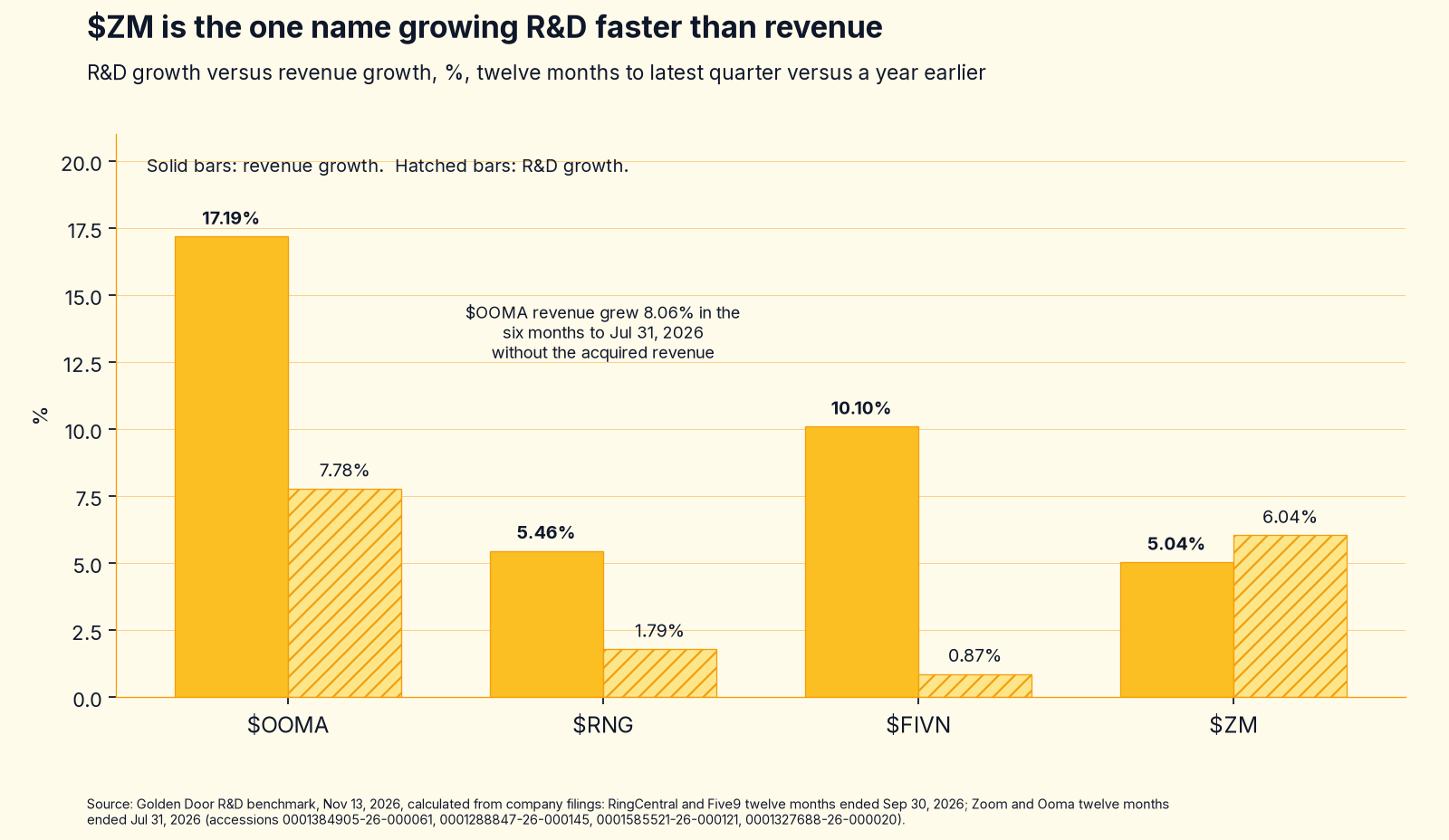
| R&D growth | 7.8% | 1.8% | 0.9% | 6% |
| Revenue growth | 17.2% | 5.5% | 10.1% | 5% |
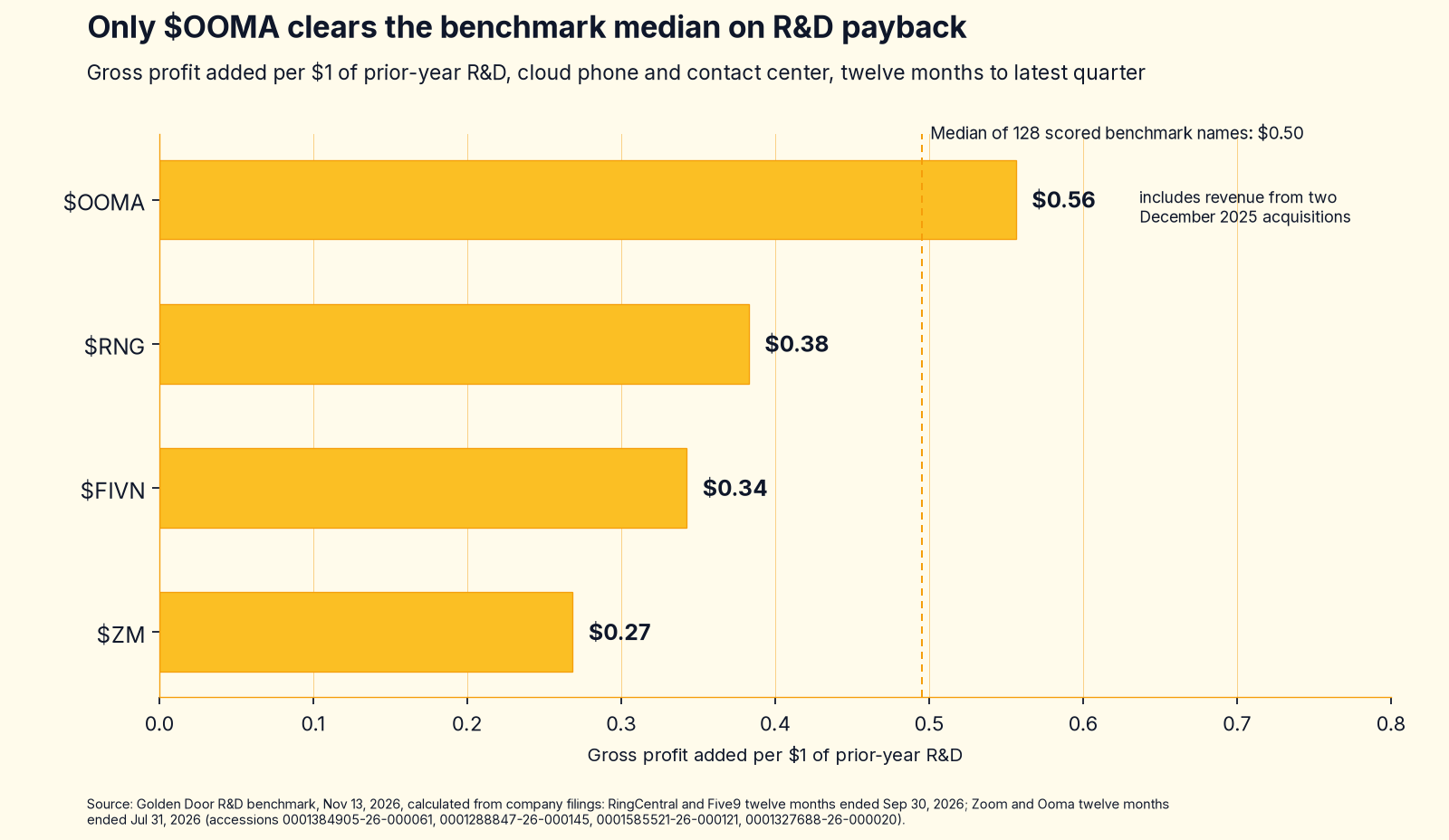
| Gross profit added per $1 of prior-year R&D | $0.56 | $0.38 | $0.34 | $0.27 |
| Gross margin | 61.5% | 72.2% | 54.5% | 77.3% |
Source: Golden Door Asset research.
1. What shipped
In under eight weeks, OpenAI turned its voice model into something that can run a phone call from start to finish without a contact center platform in the middle. Each step is dated in its own API changelog [1].
Sep 10, 2026. GPT-Live-1 became generally available. It is a full-duplex voice model, so it can keep talking while a backend model or agent handles reasoning and tools.
Voice sessions cost $0.05 per minute, billed per second, with backend model and tool use charged separately [1]. That works out to $3.00 per hour for the voice layer.
Oct 15, 2026. GPT-Live gained a native connection to OpenAI's Decisions API. An app can now act while the caller is still speaking, and GPT-Live can call Decisions directly [1].
Oct 16, 2026. Prompt-to-voice opened to all API customers. A business describes a voice in plain text and gets a reusable custom voice.
Creating the voice is free; speech is billed at the normal session rate [1].
Nov 2, 2026. Outbound SIP calling became available to all organizations through the Live API. GPT-Live can now be connected to a phone number through any SIP provider [1].
Google shipped the same capability in the same window. On Sep 15, 2026, Gemini 3.8 Live and Gemini 3.8 Live Extended Thinking became generally available in the Gemini API.
Google describes Gemini 3.8 Live as engineered for sub-second conversational latency, with native audio understanding and both synchronous and asynchronous function calling, and the Extended Thinking version as built for complex reasoning and multi-step planning [2].
So this is not one vendor's feature. Two of the largest model vendors now sell a voice that can listen, decide and act mid-call to any developer with an API key, and OpenAI's can now dial out as well.
2. Which job it changes
The job is the voice agent on a business phone line: answering inbound calls, placing outbound ones, and acting mid-call, such as booking, routing or updating a record. Until this autumn, a business that wanted a machine on its phones usually bought it from the company that already ran its phones.
That is the cloud phone and contact center niche.
The releases move three parts of that job to the model vendor:
The voice. A natural, branded voice now costs nothing to create and $0.05 a minute to run [1].
The decision. Choosing the next action during the call is now a native feature of the model [1][2].
The dial tone. Outbound calling through SIP means the model reaches the public phone network without a platform in between [1].
What the releases do not supply is everything around the call: the phone numbers and carrier relationships, the routing between machine and human agents, the full conversation history, compliance and recording, the agent desktop, and the contract with the IT buyer. The question for this niche is how much of each company's R&D builds the parts the model vendors just commoditized, and how much builds the parts they did not.
3. Four names that share the buyer
$RNG, $FIVN, $ZM and $OOMA sell cloud phone systems and voice agents to business IT and customer experience leaders, and each names voice agent products in its latest filing.
$RNG sells unified communications, a contact center and a line of voice agent products, including AI Receptionist (AIR), AI Representative Pro and AI Conversation Expert (ACE). The voice agents are priced either by usage or by seat [3].
$FIVN sells a contact center platform with the Five9 Genius AI suite. Licenses are billed per seat, its superintelligence features are billed by consumption, and telephony is billed by usage.
It reports more than 4,000 customers [4].
$ZM sells meetings and phones, plus Zoom Contact Center and Zoom Virtual Agent for customer service teams. Its own filing lists RingCentral and Five9 among its competitors [5].
$OOMA sells phone service to small businesses and homes. Ooma Business was about 70% of revenue in the quarter ended Jul 31, 2026, up from 63% a year earlier [6].
Other communications names in coverage sell to developers rather than to the IT buyer, so they are kept out of this ranking and covered separately in section 6.
4. The benchmark read: little R&D in this niche pays above the median
The opening chart ranks the four on one measure: gross profit added over the last twelve months for each dollar of R&D spent in the twelve months before. The median across the 128 scored software names in the Golden Door R&D benchmark is $0.50 [9].
$OOMA leads at $0.56, with a caveat. On Dec 1, 2025, $OOMA bought FluentStream, a small-business phone provider, for about $50.5M, and on Dec 29, 2025, it bought Phone.com for about $22.7M.
The two added $22.4M of revenue in the six months ended Jul 31, 2026 [6]. Six-month revenue rose from $131.39M to $164.38M.
Using the unrounded filing figures, growth was 25.10%; without the acquired revenue it was 8.06%. Part of the gross profit behind the $0.56 was bought rather than built.
$OOMA also has the smallest R&D base, $55.82M over twelve months, so small changes move the ratio.
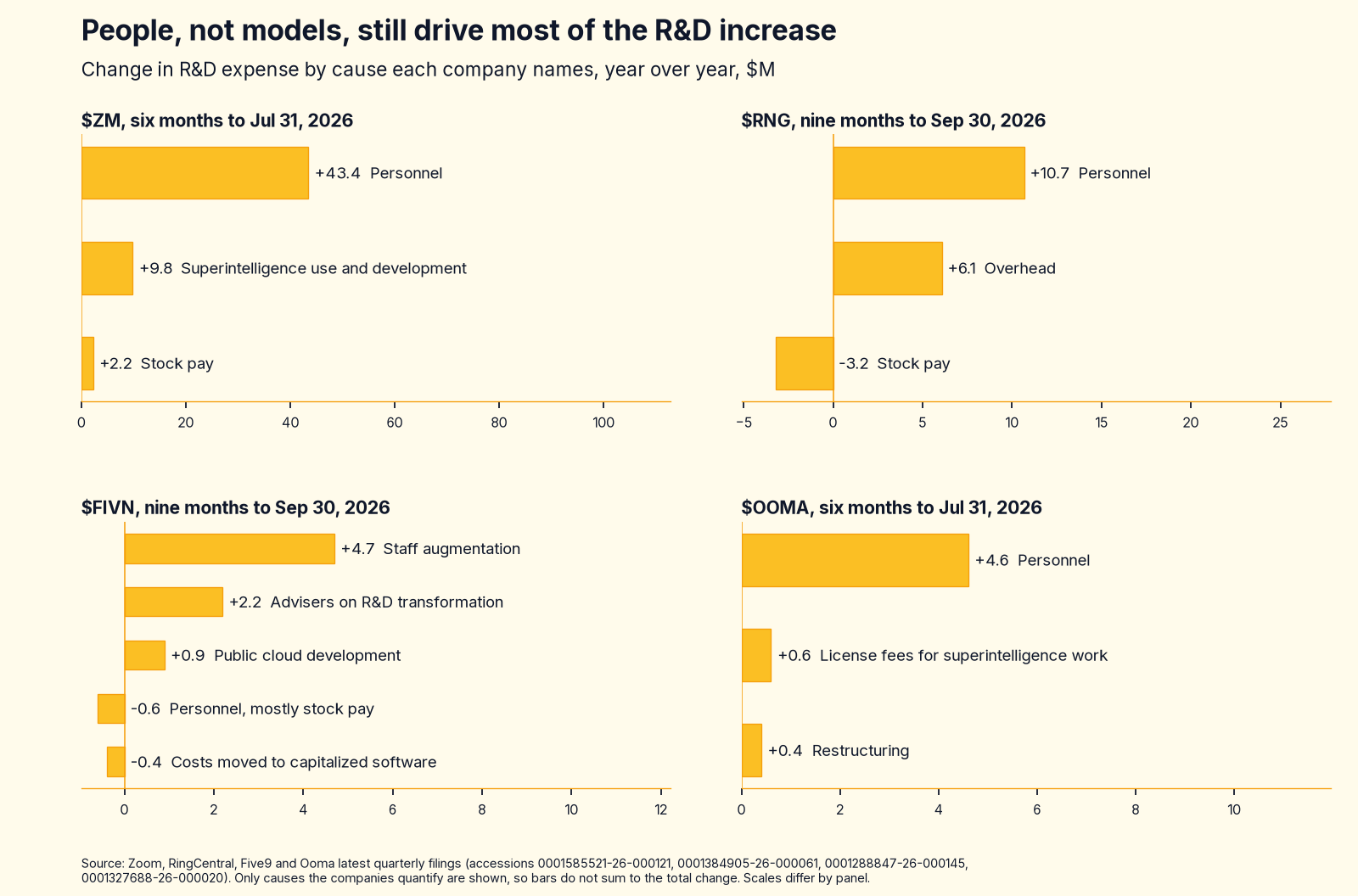
$RNG returns $0.38. In the twelve months ended Sep 30, 2026, R&D grew 1.79% while revenue grew 5.46%, so engineering spend is close to flat in a slow-growth business [9]. In the nine months ended Sep 30, 2026, R&D grew faster, 5.49%, to $252.58M, up $13.15M on $10.7M more personnel cost and $6.1M more overhead, partly offset by $3.24M less stock pay [3].
The twelve-month rate is lower because it includes the quarter ended Dec 31, 2025, when R&D was $77.56M against $84.90M a year earlier [3][9]. RingCentral states that it has invested over $250M in R&D in 2026 [3].
The filing says investment in its products, including its new superintelligence-led products, is important to future growth [3].
$FIVN returns $0.34. R&D grew 0.87% against revenue growth of 10.10%, nearly the same gap as $OOMA's without any acquired revenue [9]. Reported R&D understates development spend, though.
Five9 capitalized $38.49M of software over the same twelve months, 19.48% of R&D plus capitalized spend [9]. In the nine months ended Sep 30, 2026, the R&D increase came from $4.7M more staff augmentation, $2.2M of advisory services for what Five9 calls research and development transformation, and $0.9M more public cloud development cost [4].
$ZM returns $0.27, the lowest. It is the only name growing R&D faster than revenue: 6.04% against 5.04% [9].
5. Whose voice R&D still pays
The releases set a new floor for what a voice agent costs to build. The R&D that keeps paying in this niche is the R&D the model vendors did not make cheaper.
Read that way, the four filings point in different directions.
$FIVN is spending on the part that stays. Five9 describes its platform as the system of record for interactions and a real-time engine that orchestrates every customer interaction, whether a person or a software agent handles it [4].
That is the layer outbound SIP calling does not replace. There is a precedent in its own filing: a growing number of Five9 customers already buy telephony straight from wholesale carriers while keeping the platform subscription [4].
The phone minutes came apart from the platform once already, and the platform stayed. The risk is that Five9 sells its superintelligence features by consumption [4], and that revenue now sits next to a published $0.05 a minute.
$RNG is spending on the part that is being repriced. AI Receptionist and its sibling products are voice agents sold by usage or seat [3].
An outbound-capable model with a free custom voice is a substitute any developer can now assemble. RingCentral's advantage is distribution to the IT buyer and the phone system it already runs.
Its R&D grew 1.79% in the twelve months ended Sep 30, 2026, while two model vendors shipped the substitute in under eight weeks.
$ZM is the clearest case of R&D spent into a cheaper layer. Zoom is the only name in the niche growing R&D faster than revenue, and a named part of that R&D, $9.8M in six months, goes to model use and development [5].
Because Zoom buys models from OpenAI and Anthropic, cheaper and more capable voice models lower its input cost. But the same releases let any developer build what Zoom Virtual Agent offers.
With the lowest payback in the niche, $0.27, the extra spend has not yet shown up as gross profit.
$OOMA has the least R&D aimed at voice agents and the most exposure to cheap ones. Its six-month R&D rose $5.56M, or 22.30%, mostly from $4.6M of personnel cost; license fees for its superintelligence work added $0.6M [6].
6. Who is helped: the carriers the model has to dial through
A model that places phone calls still needs a carrier. OpenAI's changelog says to connect GPT-Live to a phone number "through your SIP provider" [1].
Two covered names sell that connection to developers. They have different buyers from the four above, so they are shown separately and not ranked with them.
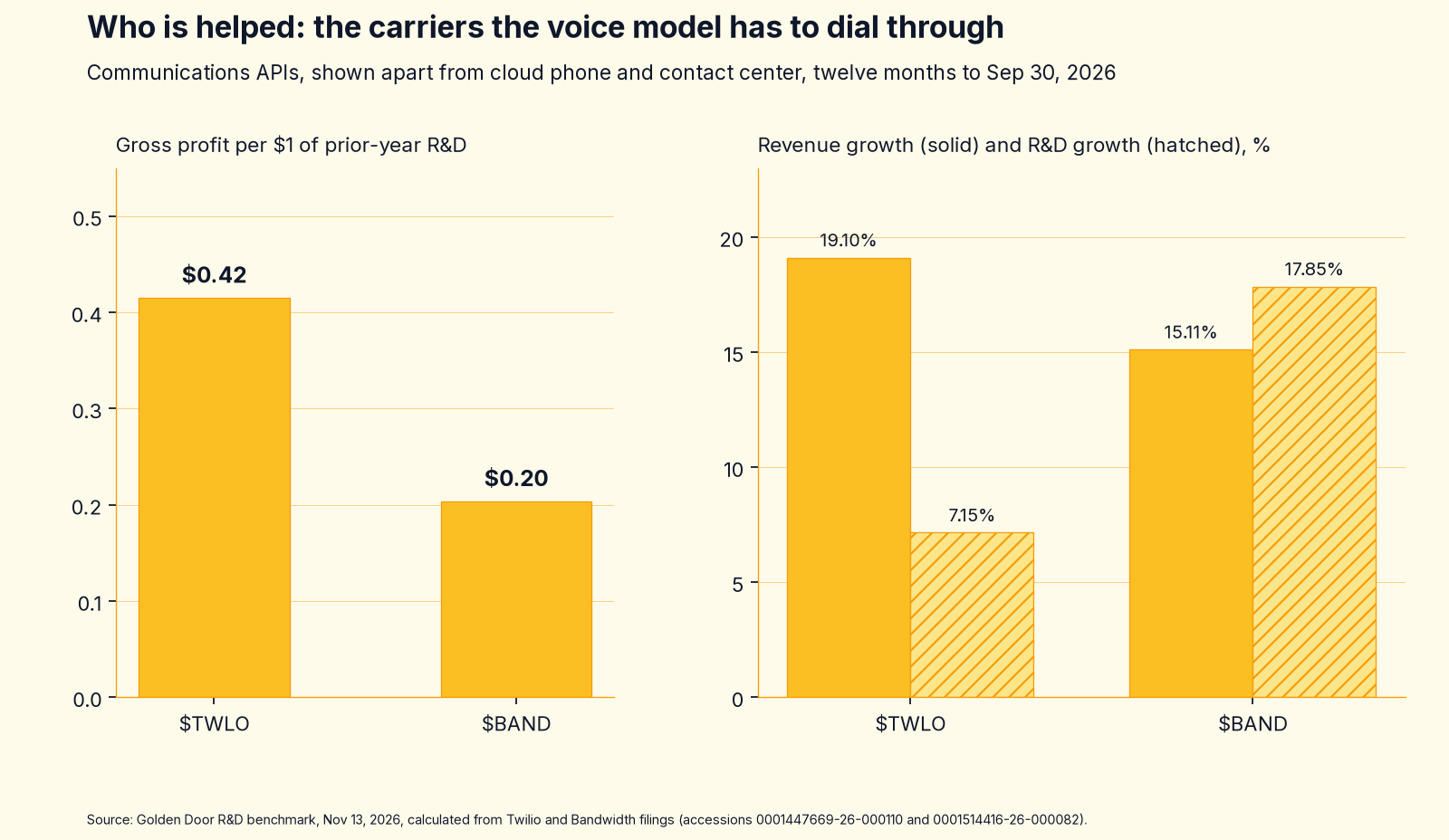
$TWLO returns $0.42 of gross profit per R&D dollar, with revenue up 19.10% and R&D up 7.15% [9]. In the nine months ended Sep 30, 2026, R&D rose $55.75M, or 7.33%.
Hosting fees for development and staging added $28.5M, about 51% of the increase, with $13.4M more personnel cost and $8.4M more software subscriptions. In the third quarter alone, impairment of capitalized internal-use software added $8.0M more to R&D than a year earlier [7].
$BAND returns $0.20, with R&D up 17.85% against revenue up 15.11% [9]. Nine-month R&D rose $16.92M, or 17.73%, from a larger R&D team [8].
Bandwidth says its Maestro platform is built to orchestrate voice agents across environments, and that its business benefits from companies adopting contact center platforms [8]. It sells to both sides of this shift.
Both are spending ahead of the volume. Every call a model places through SIP is carried minutes, whether it starts in a contact center or in a developer's code.
The filings do not yet split out how many of those minutes come from model-driven calls.
7. What to watch in the next filing
$ZM, quarter ended Oct 31, 2026. Whether the R&D line Zoom ties to model use and development keeps rising, and whether revenue growth catches R&D growth. That filing was not on EDGAR as of Nov 14, 2026, so the figures above lag $RNG and $FIVN by one quarter.
$OOMA, quarter ended Oct 31, 2026. Growth without FluentStream and Phone.com, which still sit in the year-over-year comparison until December. Also not on EDGAR as of Nov 14, 2026.
$RNG, year ending Dec 31, 2026. Any disclosure of usage revenue from AI Receptionist and its siblings, and whether personnel or model costs drive R&D.
$FIVN, year ending Dec 31, 2026. The share of customers buying telephony directly, consumption revenue from its superintelligence features, and capitalized software, which already equals 19.48% of development spend.
$TWLO and $BAND. Voice usage growth and any split of model-driven traffic.
For Twilio, whether hosting fees keep outrunning personnel in R&D.
8. Niche call
Hold off on cloud phone and contact center as a group. The voice agent, the branded voice and the dial-out were three things this niche could sell on top of the phone line.
Since Sep 10, OpenAI sells all three to any developer, and Google sells the voice and the in-call actions. Three of the four names return less gross profit per R&D dollar than the benchmark median, and the fourth clears it partly through acquired revenue.
The R&D that still pays builds routing, history and the human handoff around the call, the layer Five9 calls its structural advantage, and the next filings should show whether consumption revenue from voice agents grows faster than the R&D behind it.
The full benchmark for all 128 scored names, with each name's R&D payback, growth per R&D dollar and leverage, is at https://www.goldendoorasset.com/benchmark.
Companies Referenced in This Research
Related Coverage & Peer Deep-Dives
View All →Five9: Hold as 17.4% GAAP Free Cash Flow Conversion Offsets 11.0% Equity Dilution and Seat Debate
Enterprise CCaaS migrations and positive GAAP operating leverage lift revenue past $1.20B, but telephony gross-margin caps and 6.9% annual dilution leave shares fairly priced near $17.53 intrinsic value.