Golden Door Asset · Research
The Payment Fee Is a Toll Only After the Credit Book Is Funded
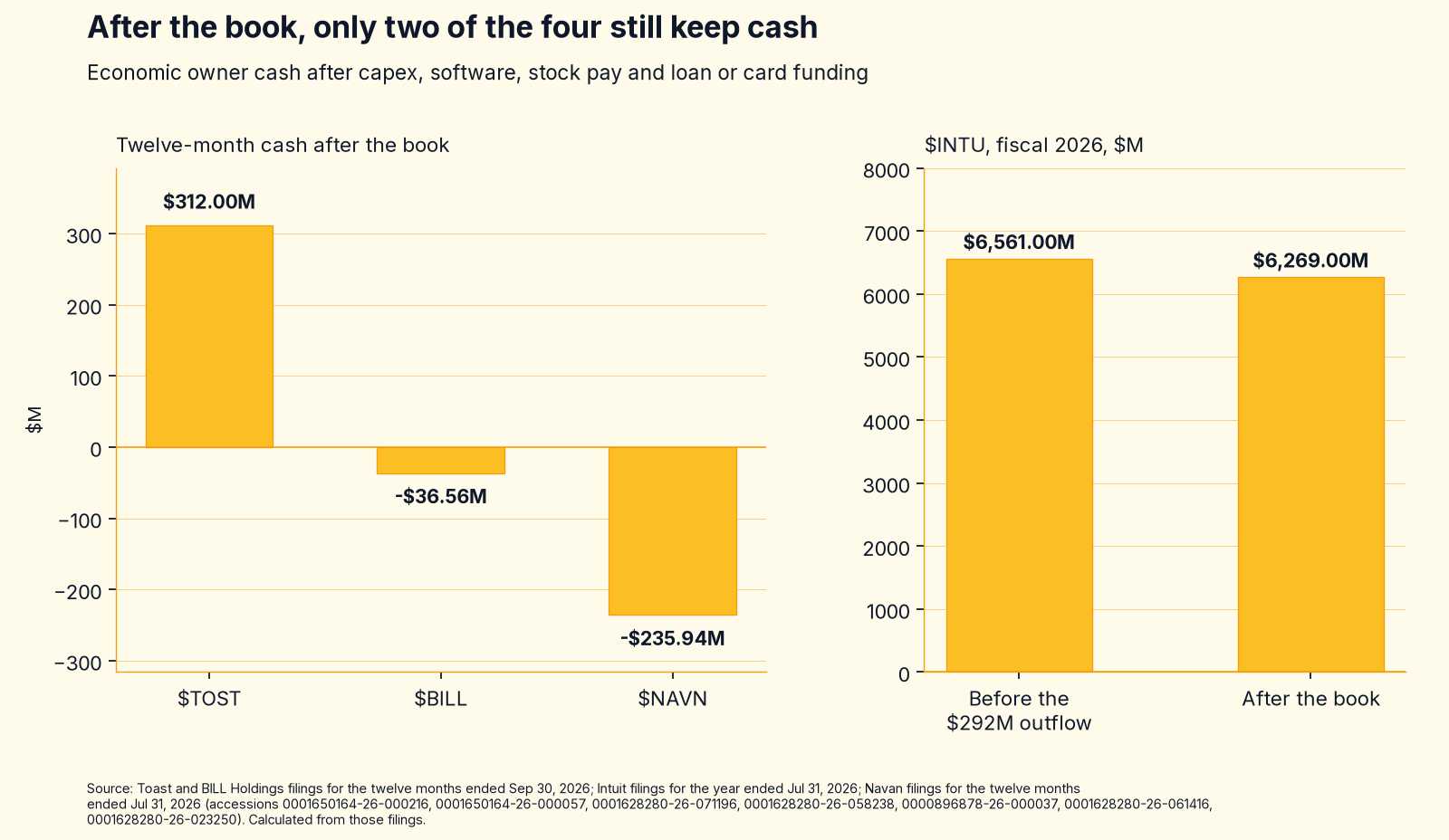
$TOST, $BILL, $INTU and $NAVN attach loans or cards to a payment rail they already run. After that book is funded, trailing owner cash is $312.00M at $TOST, $(36.56)M at $BILL, $6,269M at $INTU and $(235.94)M at $NAVN.
As of Nov 14, 2026. Figures are from primary filings. Periods differ by fiscal calendar and are labeled in the table.
This industry research issues no single-stock call. The published pages on each name remain the place for those calls.
| Metric | $TOST | $BILL | $INTU | $NAVN |
|---|---|---|---|---|
| Period | Trailing twelve months ended Sep 30, 2026, and nine months for the fee and loan lines | Trailing twelve months ended Sep 30, 2026, and fiscal 2026 for card rewards | Fiscal year ended Jul 31, 2026 | Trailing twelve months ended Jul 31, 2026, and the quarter then ended for volume |
| Payment or card volume | $173.80B of gross payment volume in nine months; about 189,000 locations [1] | $371.30B of fiscal 2026 payment volume [5] | Payments sit inside Global Business Solutions, $12,864M of revenue [8] | $4.7B of trailing card payment volume, calculated, and $1.3B in the quarter [10][11] |
| Fee kept on the attached book, before credit funding | $177.00M of nine-month Toast Capital gross profit [1][3] | $327.95M of fiscal 2026 net card revenue after $347.61M of rewards, 51.45% of gross card revenue [5][6] | Interest income on business loans is not material; originations and purchases were $6,755M [8] | Card spend is inside usage-based revenue; that line was 90.81% of the $232.79M quarter [10] |
| Credit cost or book funding | $54.00M of nine-month loan-guarantee provisions and $78.00M of net loan purchases [1] | $69.50M of trailing credit-loss provisions and $(180.17)M of net card and loan investing [4][5] | $165M of net charge-offs and a $292M net notes-receivable outflow [8] | $2.42M of trailing card-loss provisions, calculated, and $30.14M of card-receivable funding [10][11] |
| Economic owner cash after capex, software, stock pay and the book | $312.00M [1][2] | $(36.56)M [4][5] | $6,269M [8] | $(235.94)M [10][11] |
Source: Golden Door Asset research.
1. One question, four names that share it
The question this research answers is simple. When a software company attaches loans or cards to a payment rail it already runs, do owners keep the fee, or does funding the credit book take the cash?
The four names in this piece share that mechanism, and they share the buyers and risks that come with it. $TOST runs the restaurant point of sale and the card-present rail, then markets Toast Capital working-capital loans repaid from daily Toast-processed sales [1][2].
$BILL runs accounts payable and receivable for small and midsize businesses, then issues BILL Spend & Expense corporate cards and invoice-financing loans [4][5]. $INTU holds the QuickBooks ledger, payroll and payments, then funds QuickBooks Capital loans off that file [8].
$NAVN books business travel and expenses, then issues physical and virtual corporate cards whose receivables sit on its balance sheet and are funded by a warehouse line [10]. In each case the customer already on the software is the same customer who borrows or swipes.
Other fintech and banking-software names in the same coverage batch sell a system of record or a rail to a bank or a lender that carries the credit itself. They are left out of this piece because the buyers and the credit risk are not the same.
2. How the fee and the book are booked in different places
On the way to the income statement, the fee often looks clean. $TOST puts Toast Capital facilitation and servicing fees inside non-payments fintech gross profit, $177.00M in the nine months ended Sep 30, 2026, with no credit-loss provision in cost of revenue.
The loan-guarantee provision, $54.00M for those nine months, is recorded in general and administrative expense, inside $87.00M of consolidated credit-loss expense that also includes merchant-receivable bad debt the filings do not split [1][2]. Matching only the $54.00M lending-specific floor cuts the $177.00M fee line by 30.51%, to $123.00M, calculated [1].
The loans themselves are originated by a Utah-chartered bank partner. $TOST is obligated to buy back loans that become delinquent or default, up to a cap the filings do not quantify, and in 2026 it also began purchasing non-delinquent performing loans onto its own balance sheet [2].
Those purchases, $145.00M against $67.00M of repayments, left $70.00M net held for investment at Sep 30, 2026, versus $0 at year-end 2025, and they sit in investing cash flows, outside reported free cash flow [1].
$BILL's presentation is different and, for owners, more expensive. Fiscal 2026 gross card revenue was $675.55M, of which $347.61M, or 51.45%, was rebated as rewards [5][6].
Effective Jul 1, 2026, those rewards were reclassified from sales and marketing expense to contra-revenue. The shift added nothing to GAAP operating income or cash flow, and it lifted reported margin percentages by shrinking the revenue denominator [4][6].
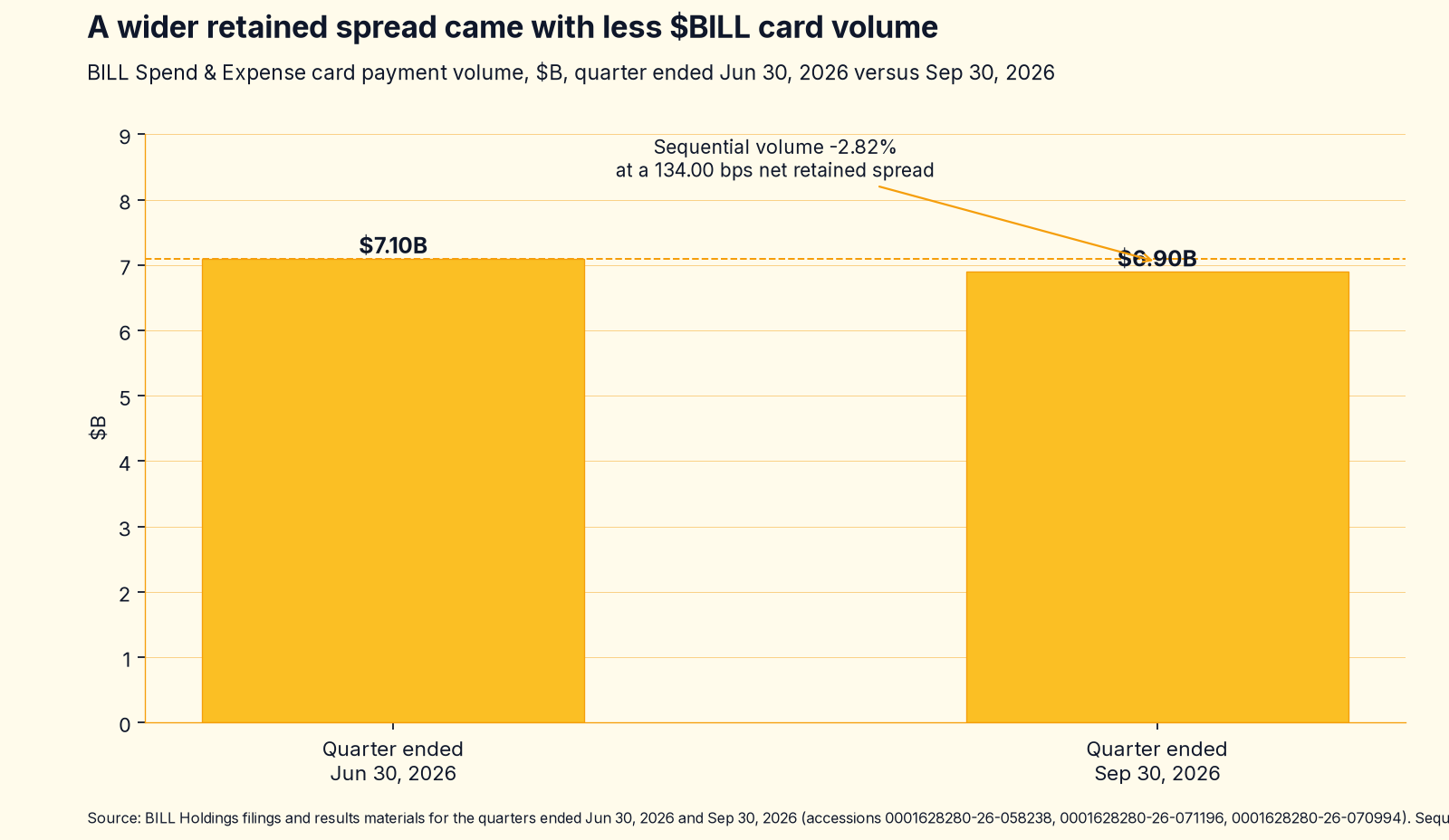
In the first quarter of fiscal 2027, net retained card spread rose to 134.00 bps and sequential card volume fell 2.82%, from $7.10B to $6.90B [4][7]. Over the trailing twelve months ended Sep 30, 2026, $BILL added back $69.50M of credit-loss provisions inside operating cash flow and recorded $(180.17)M of net investing cash for acquired card receivables and invoice loans [4][5].
Gross card receivables were $905.47M at Sep 30, 2026, supported in part by $330.00M drawn on card warehouse lines [4].
$INTU's fiscal 2026 originations and purchases of notes receivable held for investment were $6,755M, up 69.21% from $3,992M. Sales were $2,210M and principal repayments $4,253M, a $292M net investing outflow, calculated [8].
3. Owner cash after the book is the measure that matters
Economic owner cash here is operating cash flow, less cash spent on property and equipment and capitalized software, less stock pay, less the investing cash that funds loans or acquired card receivables.
On that measure the four names already split. $TOST generated $668.00M of trailing operating cash flow and $604.00M of reported free cash flow.
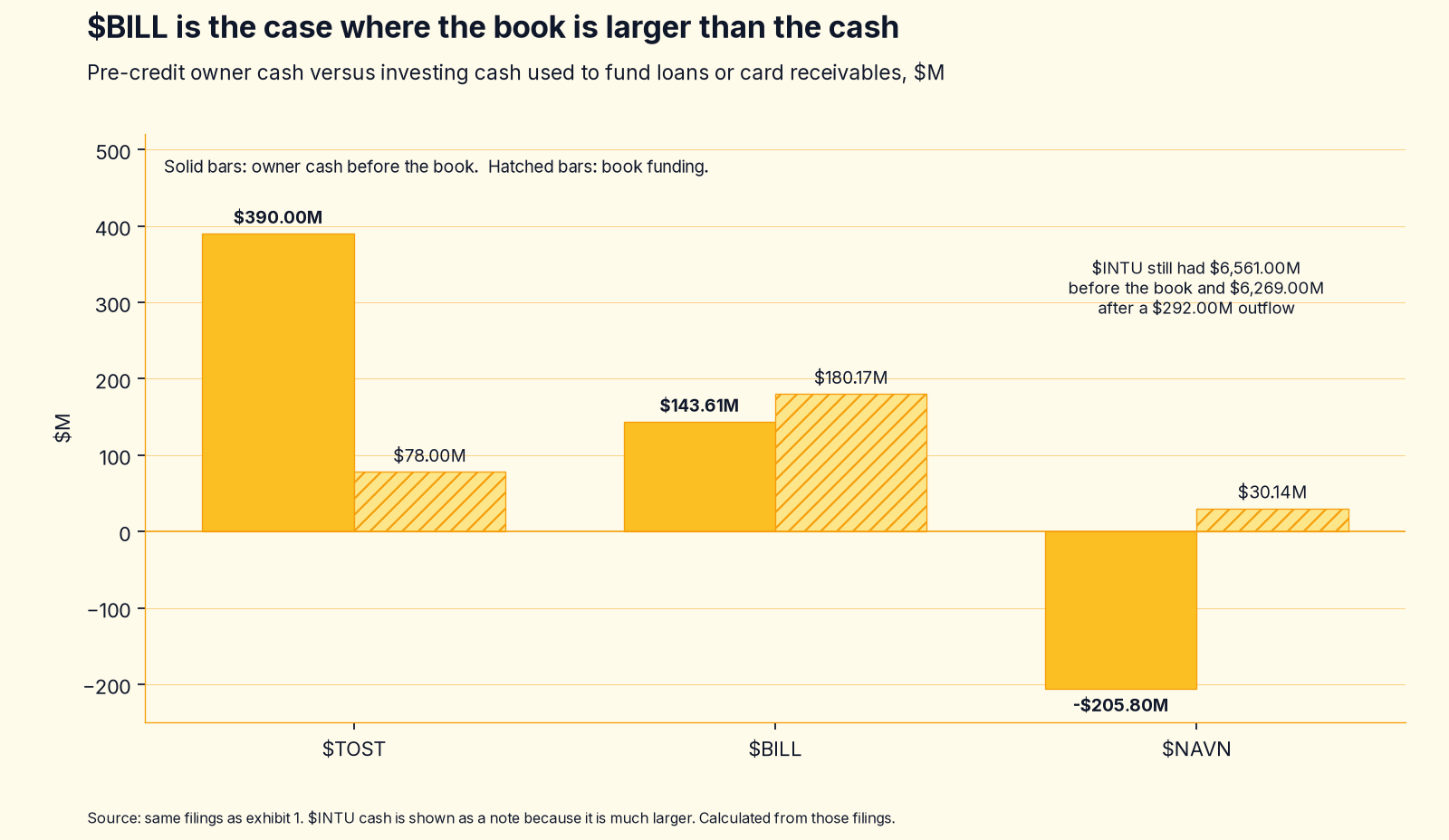
After $214.00M of stock pay, $390.00M remained, and after $78.00M of net loan purchases, $312.00M remained, calculated [1][2]. The toll is still cash, and it is already about half of the free-cash-flow headline, in the first year the performing loans came on balance sheet.
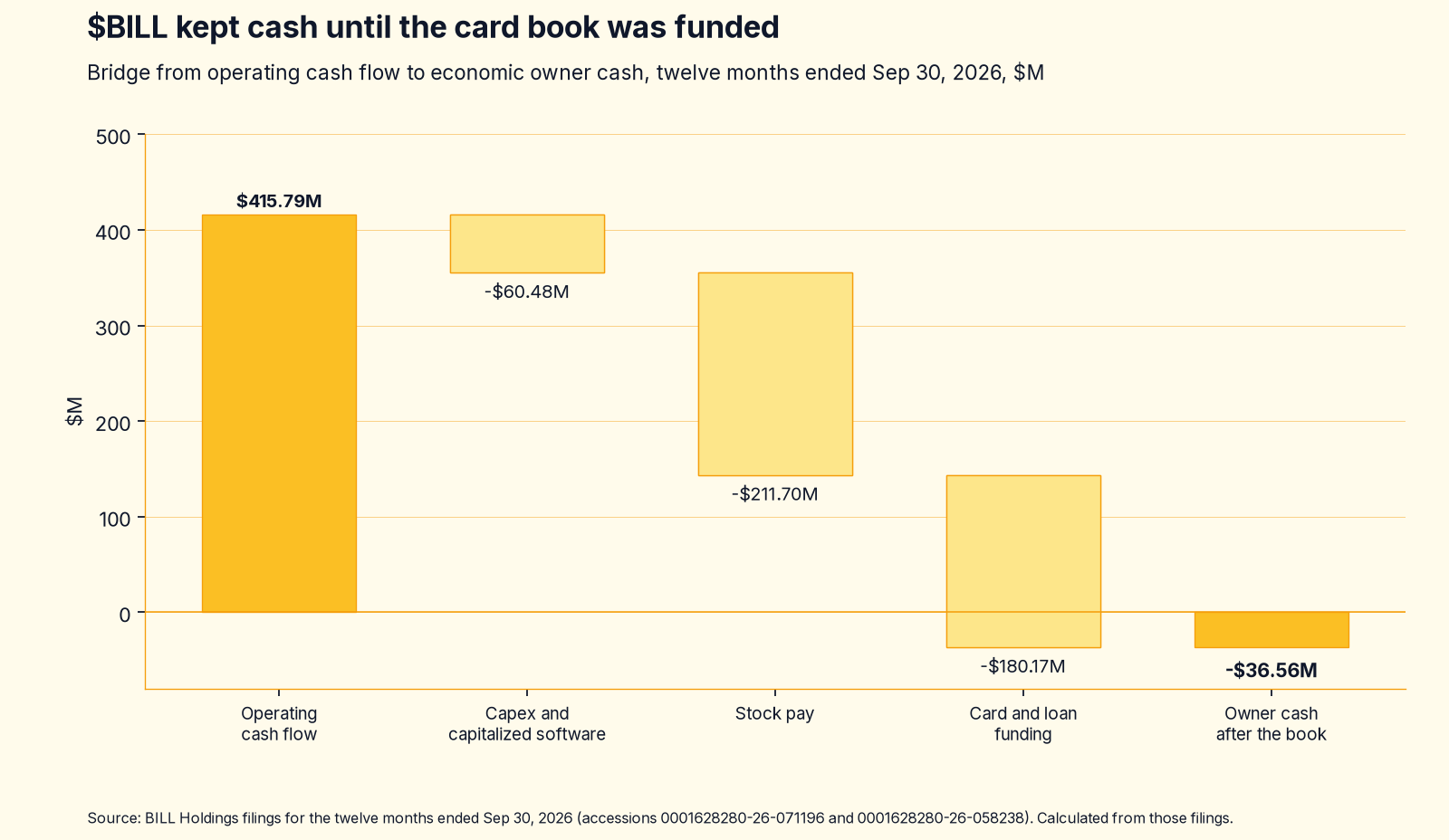
$BILL generated $415.79M of trailing operating cash flow and $355.31M of reported free cash flow, after $2.12M of property and equipment and $58.36M of capitalized software, calculated [4][5]. After $211.70M of stock pay, $143.61M remained.
After $(180.17)M of net credit-book investing, economic owner cash was $(36.56)M, calculated [4][5]. This is the cleanest illustration of the thesis: the pre-credit figure is positive, and the book takes it.
$INTU generated $8,838M of fiscal 2026 operating cash flow. After $175M of property and equipment, $46M of capitalized software and $2,056M of stock pay, owner cash was $6,561M.
After the $292M notes-receivable outflow, $6,269M remained, calculated [8]. The ledger still pays owners.
The book does not erase that cash, and it also does not explain it: the interest is not material, and net charge-offs have more than doubled on a $1.5B net retained book [8].
$NAVN generated $47.28M of trailing operating cash flow, calculated. After $1.76M of property and equipment, $19.84M of capitalized software and $231.48M of stock pay, including capitalized amounts, the pre-credit figure is already $(205.80)M.
The $30.14M of card-receivable funding takes it to $(235.94)M, calculated [10][11]. Stock pay is the first drain.
The card book is a real second one, not the main one.
4. What would break the thesis
The payment rail is not in dispute. $TOST processed $173.80B of nine-month gross payment volume, up 21.03%, at a 50.29 bps pure payment spread [1][3].
$BILL's network still moved $371.30B in fiscal 2026 [5]. $INTU still owns the books those payments post to [8].
$NAVN's gross booking volume was $3.0B in the quarter, up 45%, and $11.1B trailing, calculated [10][11]. Superintelligence agents that pay a vendor, close a month, or file a return still have to read and write those records, which is a tailwind for the ledger and the point of sale and a harder test for a middle layer that syncs to someone else's books.
What breaks the thesis is a book that keeps taking cash, or a fee that can be kept only by shrinking volume.
At $BILL, the test is already live. Lifting retained spread to 134.00 bps coincided with a 2.82% sequential drop in card volume, and trailing economic owner cash is already negative [4][7].
A second quarter of flat or lower volume at that spread, or trailing economic owner cash that stays negative, would confirm that the rebate was buying the book.
At $TOST, guarantee provisions of $54.00M already remove 30.51% of the nine-month Capital fee line, and the held-for-investment balance has gone from $0 to $70.00M in nine months [1]. On Oct 29, 2026, the Federal Trade Commission, seven states, San Francisco and Los Angeles County sued Toast in the Northern District of California.
The complaint alleges, among other contract terms, that Toast Capital treats a switch of point-of-sale provider as a loan default, a clause that does not appear in the fiscal 2025 Form 10-K and is addressed in the later Form 10-Q only as a contingency the company cannot estimate [1][2][9]. An injunction that voids that clause, or further growth in on-balance-sheet loans and guarantee provisions as a share of Capital fees, would show the rail and the book are legally tied, not merely adjacent.
At $INTU, net charge-offs of $165M already exceed the $134M reserve, and the commitment periods on the secured facilities begin to end in April and August 2027 [8]. If net charge-offs stay above the reserve, or if those facilities are not extended, the claim that the ledger underwrites a self-funding book would be weaker, even though group owner cash would still be large.
5. Published values, in total dollars, and what to read next
This piece does not set a new value or a new call on any name. The figures below are the Nov 14 published base equity values, in total dollars, against market value at the Nov 13, 2026 close used on those pages.
The published $TOST base equity value is $17,271.63M, 15.87% below the $20,530.56M diluted market value, and it is already built on the $312.00M of economic owner cash after loan funding [1][12]. The published $BILL base equity value is $3,024.74M, 35.36% below the $4,679.05M market value, after a trailing economic owner cash figure of $(36.56)M [4][13].
The published $INTU base equity value is $112,326.59M, 23.01% above the $91,314.54M market value, using owner cash before the $292M loan outflow and a tax-normalized anchor on that page [8][14]. No base value is set here for $NAVN, because trailing economic owner cash after the book is negative, and a negative anchor is not turned into a base value.
Confirmed or dated items to watch, without treating unposted earnings dates as fixed: initial filings in FTC v. Toast, Inc., case number 3:26-cv-12705, filed Oct 29, 2026 [1][9]; $BILL's $123.55M convertible notes due Apr 1, 2027 and the $150.00M Odin warehouse line due November 2027 [4]; $INTU facility commitments beginning April and August 2027 [8]; and $NAVN's warehouse maturity on Feb 18, 2028 [10].
Earnings dates that have not been posted on the investor-relations sites as of Nov 14 are unconfirmed.
The four published deep dives are the place to go next, in this order, because each already works the same mechanism in more depth: BILL Holdings, Toast, Intuit, and Navan. Model pages: /model?ticker=BILL, /model?ticker=TOST, /model?ticker=INTU, and /model?ticker=NAVN.
Bottom line
A payment fee attached to a loan or a card is not, by itself, a toll. $TOST still kept $312.00M of trailing cash after funding a new on-balance-sheet loan book, and $INTU still kept $6,269M after a $292M notes-receivable outflow, even as Capital losses doubled and the yield was not material.
$BILL's trailing owner cash flipped from $143.61M before the book to $(36.56)M after it. $NAVN's trailing owner cash is $(235.94)M, first because of stock pay and then because of card-receivable funding.
The names that belong together share three traits: software, a payment rail, and a book whose cost shows only once the investing section and the provision lines are counted.
Companies Referenced in This Research
Related Coverage & Peer Deep-Dives
View All →Toast Owns the Restaurant Counter and Payment Rail, yet Lending Drag, FTC Lock-In Risk, and Valuation Keep Us on Hold Off
$TOST runs the live point-of-sale, kitchen, and payment operating system across about 189,000 restaurant locations and widened its pure payment spread to 50.29 bps, yet $54.00M of nine-month loan-guarantee provisions inside $87.00M of G&A credit losses, $78.00M of on-balance-sheet loan funding, a federal and multi-state ROSCA suit that names Toast Capital loan terms, and a market value 18.87% above Base DCF leave no margin of safety.